



One of my earlier AI Maker newsletter setups was built around a giant master prompt.
It told Claude who I was, who I wrote for, how my voice sounded, what I believed about AI, what kind of content I wanted to create, and how I judged whether an answer was useful.
Here’s the post if you want to see it:

It included my audience, content pillars, goals, operating modes, quality rules, and all the things I wanted the AI to challenge.
Basically, I tried to set up the entire relationship with the AI upfront. I even created multiple Claude projects tailored to specific use cases such as writing, product offerings, research, and more.
Looking back, those were the good old days. I learned a lot from that experience.
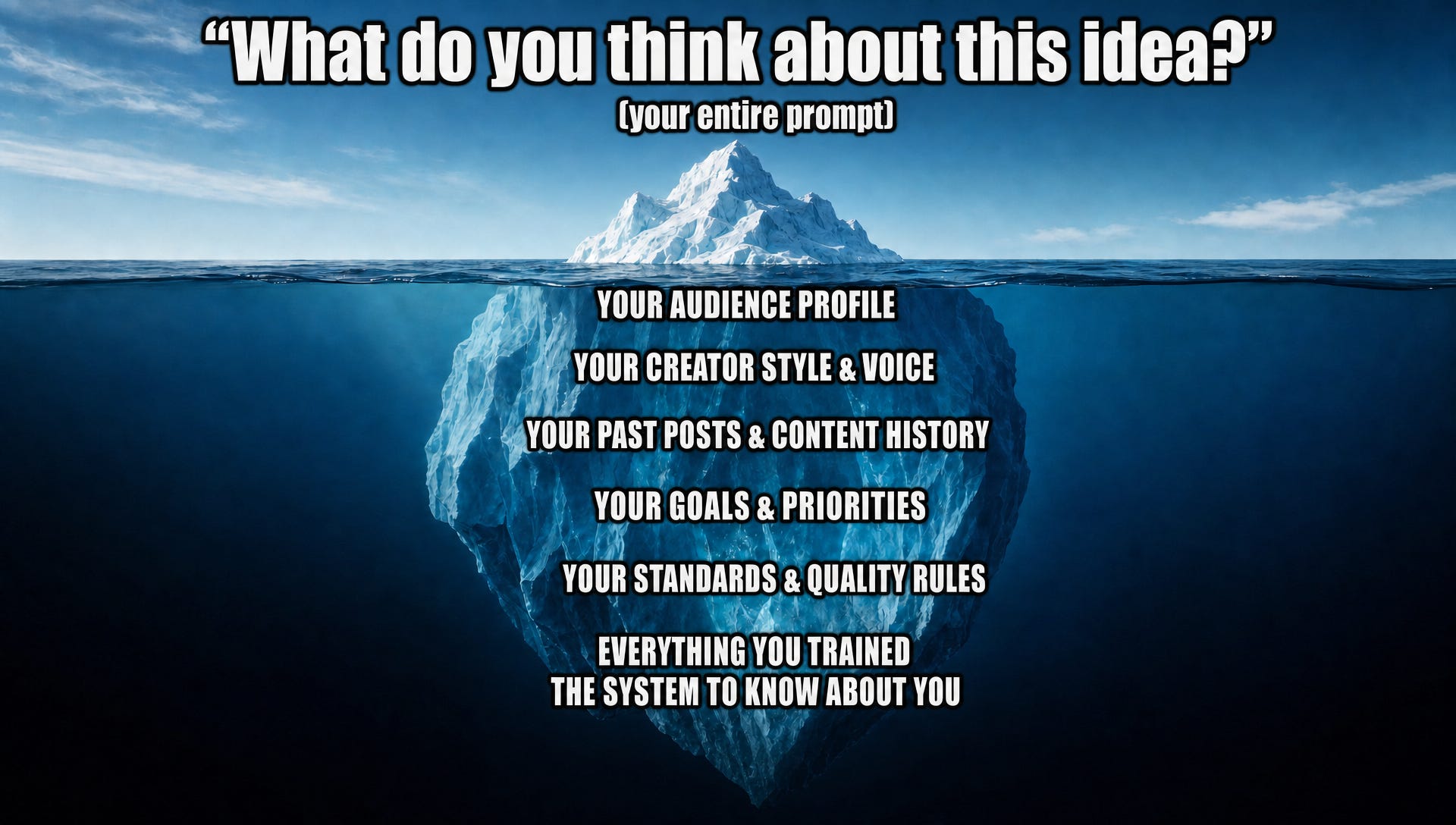
But these days, when I have a rough post idea or something I want to talk about, I rarely go to Claude Chat anymore. Since my agent knows everything about my business, I usually start with one question:
What do you think about this idea?
That is close to how this post began.
I had a half-formed thought that one sign your AI system is improving is that your prompts get shorter. I shared the idea, asked what the agent thought, and started talking through it.
There was no giant briefing attached.
The agent already knew my audience. It knew how I write. It knew the ideas I had covered before, the kind of reasoning I find useful, and the standards I use when deciding whether something belongs in AI Maker.
So the conversation could start from the idea itself.
That is when this became obvious to me: the better my AI system gets, the less I have to explain every time I use it.
What Changes When Your AI Already Knows Your Work
For a long time, I thought getting better at AI meant getting better at preparing prompts.
You define the role. Add background. Explain the audience. Include examples. Set the format. List the constraints. Tell the AI what to avoid.
All of that can improve an answer.
But it also means you have to prepare everything before the real conversation happens.
This is still how AI works when you rely on standalone chats or projects that carry very little background. Every request begins with another briefing.
You can use AI every day and still carry the real system in your own head: the audience, the standards, the examples, the history, and the process.
The AI may help complete the task, but it cannot build on much from the task before it.
This got me thinking: If I keep doing the same work and need to provide the same background every time, the setup has not improved around that task yet.
A better system should gradually absorb some of that repeated explanation.
The way I work now feels different.
I can bring an idea to my agent and ask what it thinks. If I do not like the answer, I keep talking. I question the reasoning, clarify what I meant, reject an angle, or follow one part that feels more interesting.
After a few conversations, I usually have a better sense of the angle, the outline, or what I actually want to write.
It feels closer to a brainstorming session with someone who already knows my work.
Sometimes it feels a little like having my own Jarvis.
The prompt is still there. It just has a smaller job.
How the Context Funnel Makes Shorter Prompts Possible
So, you might be wondering how I went from writing long, detailed prompts with background, audience, style, and rules… to using short prompts instead.
Think of this as a context funnel. Your AI system may have access to a large body of project knowledge, but only a small part of it should enter the current conversation.
The system narrows that knowledge to what the task needs. Your prompt adds what changed today: the new idea, source material, constraint, or decision.
One name for the work behind this is context engineering.

I heard about it first time a year ago from Tobi Lutke, CEO of Shopify.
Context engineering means deciding what information an agent should have available, how it can find that information, and when it should bring it into the current task. Basically, you are surrounding the agent with the context it needs when making a decision.
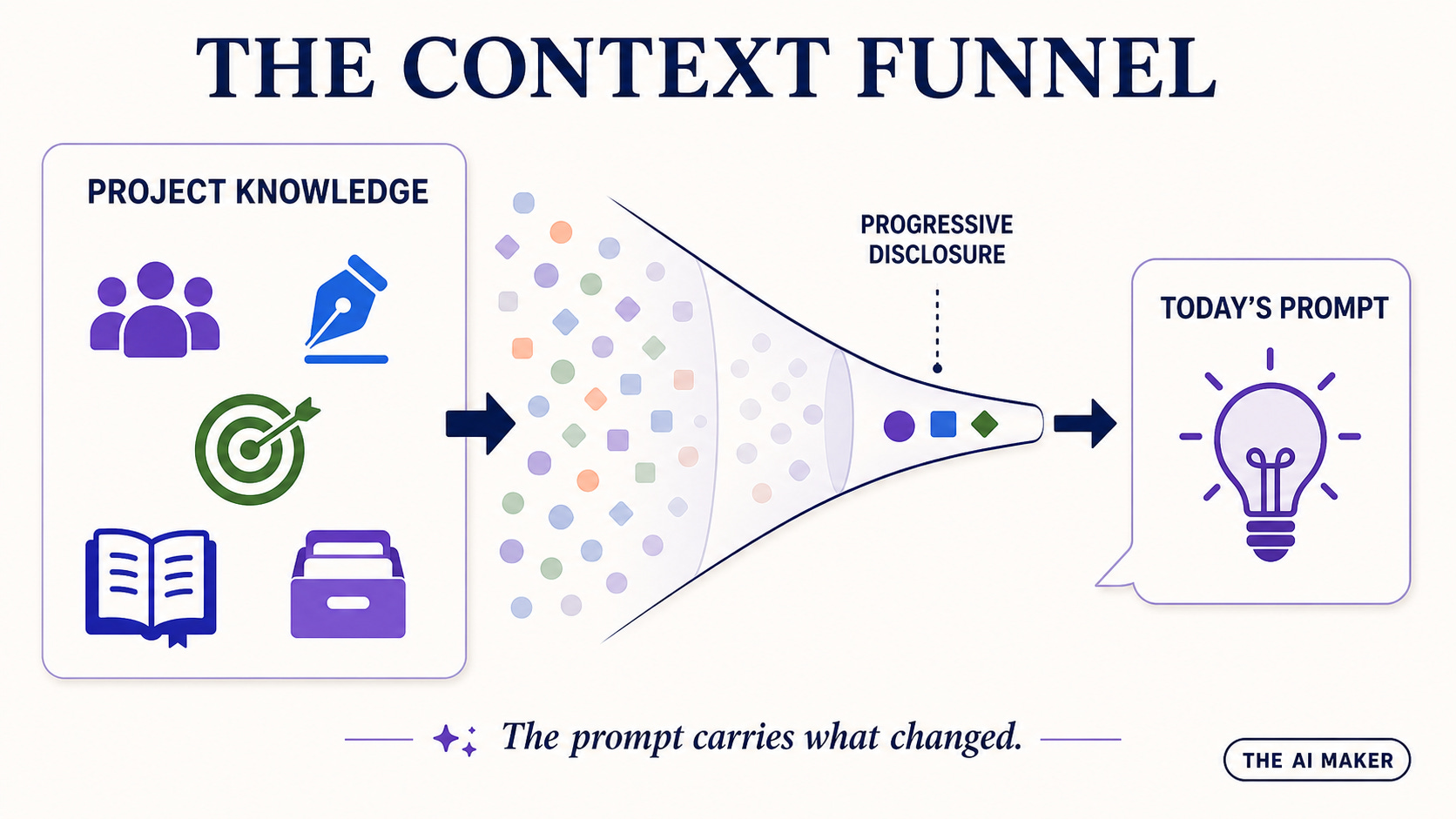
That usually means keeping the active context selective, which leads to another term called progressive disclosure. This means the agent needs the right information at the right time for the current decision. Loading the entire archive at once can confuse the agent and lead to context rot.
Files are one way to make that possible. Instructions (CLAUDE.md or AGENTS.md), examples, tools, conversation history, and saved corrections can also shape what the agent knows at a particular moment.
Inside this AI Maker project, I have a foundational folder containing the information my agent needs before helping with my work.
Three parts make a big difference:
My audience profile explains who I write for, what they already understand about AI, what they are trying to do, and where they keep getting stuck.
My creator style explains how I want the writing to feel, what standards matter to me, what evidence I need, and which writing habits make the work sound generic.
My operator profile explains how I think, how I make decisions, when I want the agent to challenge me, and how I prefer to work through an uncertain idea.
Other project files hold my current priorities, past posts, product direction, monetization framework, and the rules for different kinds of writing: LinkedIn, Substack Notes, sales email, welcome email, about page, etc.
So when I ask, “What do you think about this idea?” the agent has something real to judge it against.
It can consider whether the idea fits my readers. It can notice whether I have already covered something similar. It can challenge an angle that feels too generic. It can help me reason through how the thought connects to the larger work I am doing.
A writing agent may need access to your past archive, sentence-level style patterns, stories you can draw from, an idea inbox, topics you return to, and examples of work you would or would not publish.
A marketing agent may need information about the company or team, its positioning, audience, current goals, important metrics, campaign history, and approved claims.
The system also needs to know where that information lives and how to retrieve the relevant pieces. Some of it can remain stable; you don’t need to update it regularly. However, current goals, metrics, and priorities need to be maintained as the work changes over time.
I still make the final decision. I still disagree with the answer and change direction.
But what I find most effective with my current workflow is that I can simply continue the conversation instead of re-explaining everything every time I prompt it.
What Your System Should Store and What Today’s Prompt Should Carry
When the agent already knows everything about your work, what does the real job of the prompt become?
This is the simplest way I have started thinking about it.
Some information stays relatively stable:
Who you are helping
What you are trying to achieve
How you judge good work
What your voice sounds like
Which examples represent your standard
How a repeated task usually works
Other information changes every time:
The new idea
The material you want to work on
A decision you need to make
A special constraint
The output you need today
The stable information can live in your project files. The system can retrieve the relevant parts. Your prompt can focus on the second list.
For example, some of you may know, I’m currently building an AI course, Agentic Academy. Since this course is an expansion of my business, it’s still part of the AI Maker project.
When I started building the course, my existing AI Maker project knew nothing about it.
The agent did not know what we were trying to create. It did not know the goal. It did not know which priorities mattered or how this new project related to the rest of my work.
So I had to explain everything in detail.
Honestly, that was tiring. I had become used to having short conversations inside my newsletter project, and suddenly I was back to preparing long instructions again.
But, once I saved the course goals, priorities, and materials inside my project folder, I no longer had to explain everything from scratch.
Now, if I want to sharpen the offer idea for my course, I can simply talk through it.
Audit the Context You Keep Repeating
You do not need to create a huge AI system before you can reach this point.
Start with something you already do repeatedly, such as writing an article, researching a topic, reviewing a document, or preparing a campaign.
Then run this small audit:
Collect three recent prompts for the same task. Use requests you actually sent to your AI, including any follow-up messages you needed before the answer became useful.
Mark anything you explained more than once. Look for repeated information about your audience, goals, quality standards, preferred process, useful examples, or corrections you keep making.
Give each repeated detail a reusable home. Put facts and goals in a project brief, rules in your instructions, strong examples in an examples folder, repeated steps in a checklist or workflow, and useful corrections in the lesson file.
Run the task again with a shorter request. Include the new material, today’s goal, any changed constraints, and the output you need. Let your saved context provide the background it needs to execute your request.
Check whether it worked. Did the agent understand the task without another briefing? Did the result still meet your standards? Did it require less correction? If quality declined, identify what was missing and add that information to the appropriate source before trying again.
By the end of the audit, you should have one piece of reusable context, one shorter test prompt, and a clear comparison with your previous result.
If you want more practical steps on how to do this, you might want to read my beginner-friendly series on agentic workflows here:
The Complete Guide to Building Your First Agentic System (That You Can Actually Trust)
From Blank Folder to Working System: How to Set Up Any Project in Claude Code
How an Agent Harness Made My Claude Code Setup 10x More Reliable
The Complete Guide to the Context Folder That Changed How I Work With AI Agents
The Complete Guide to Build Your Personal AI Operating System With Claude Code
This is roughly how my newsletter setup grew. The first version only needed to turn an idea into a post in my style. Later, I needed idea capture, social content, monetization thinking, and product direction. As those needs appeared, the information around the system evolved too.
So, here’s what you need to do after the audit: run the task, have a conversation, notice what the agent still doesn’t understand, and add what’s missing once the need becomes clear.
Do not overcomplicate it.
Start small and let the system evolve as your work evolves.
Eventually, you may notice that your own requests are changing. You stop preparing a complete instruction before every interaction. You start speaking more naturally, challenging the answer, and developing the work through conversation.
Your prompts get shorter because the system finally has more of the truth.
That is one of the clearest signs your AI system is actually getting better.
The repeated-context audit is the part I think everyday users could benefit from most. If I find myself explaining the same thing to AI twice, that’s probably a better signal for what should become reusable context than trying to design the “perfect” setup upfront.
My biggest takeaway...Don’t measure a good system by how much context it stores. Measure it by how little repeated explanation you have to do without creating another system you have to babysit.