

I Built the Newsletter Growth Tool I Kept Wishing Existed
Newsletter Compass helps creators improve subject lines, repurpose posts, polish onboarding, and grow from their archive.



I want to share something a little more personal today. This is partly a product update, but mostly it is the story behind something I have been building because of a problem I kept running into while growing AI Maker.
When I started this newsletter, I thought the hard part was writing the post.
And that part is still hard. But after doing it for a while, I realized there is another layer of work that quietly piles up around the writing.
You finish the post, then you still need to decide what to call it. You need a subject line people will actually open. You need to turn it into a LinkedIn post or Substack Notes. You need your About page to explain why someone should subscribe. You need your welcome email to make new readers feel like they made the right choice. You need the post to be easier to find later.
None of those tasks are the main newsletter, but they matter.
And because they are not the main newsletter, they are easy to delay.
That was the loop I kept running into. I would write the post, feel like the hard part was finished, then realize I still had a pile of repetitive growth tasks around it. The annoying part was not that those tasks were impossible. The annoying part was that they were mechanical, easy to avoid, and still important.
That is where I started thinking differently about AI.
Maybe the most useful place for AI in newsletter creation is not replacing the main draft. Maybe it is helping with the repeated growth work around a newsletter you are already writing.
That is the idea behind Newsletter Compass, which I built with Joel Salinas. Joel is a newsletter creator who writes Leadership In Change. So we have both been looking at this from the same practical question: how do you make the growth work around a newsletter less scattered?
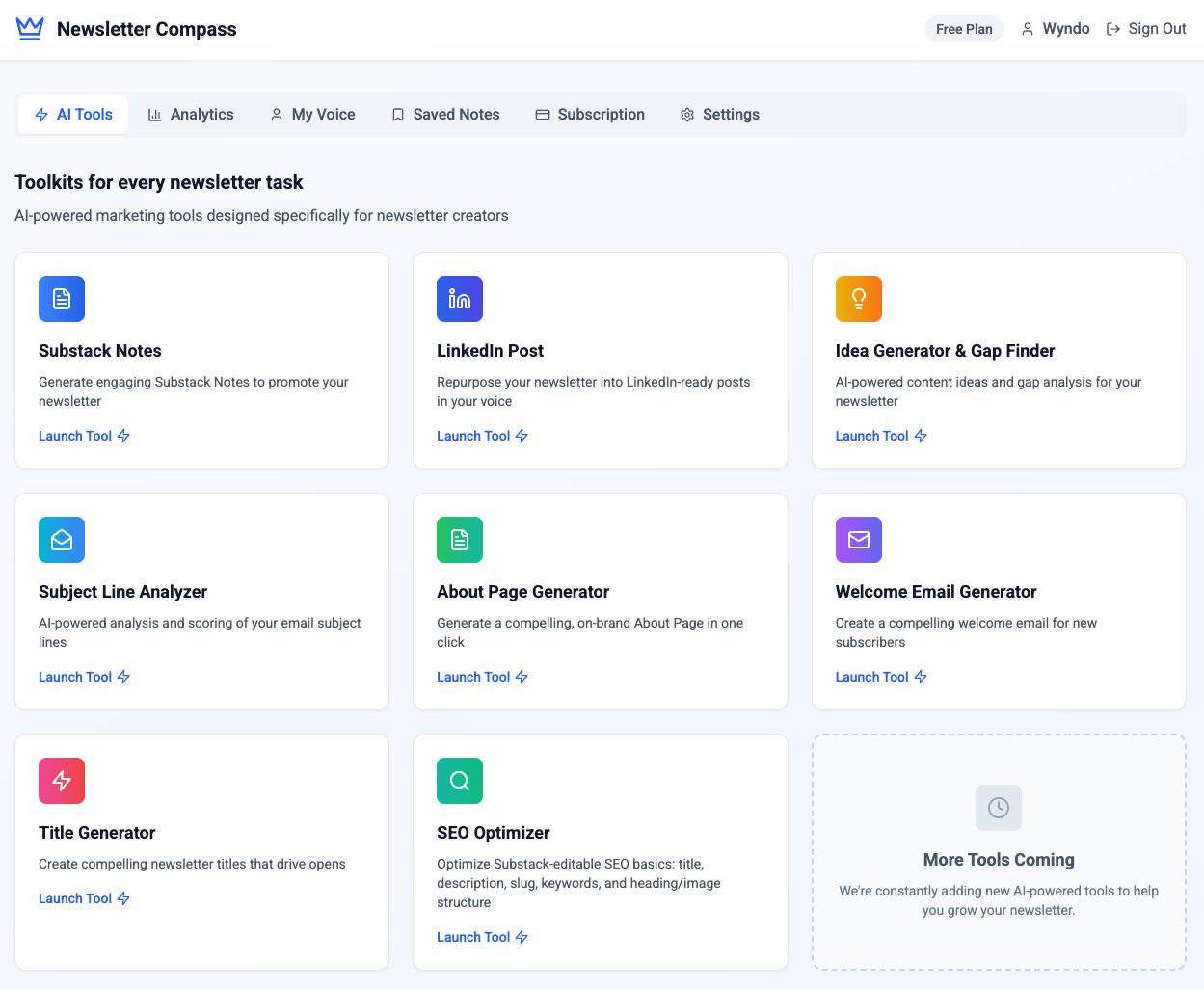
To put it simply, Newsletter Compass is a growth toolset for newsletter creators. It helps with ideas, titles, subject lines, Substack Notes, LinkedIn posts, welcome emails, About pages, and SEO.
The newsletter is still yours. The tool helps you do more with it.
The Problem I Wanted To Solve
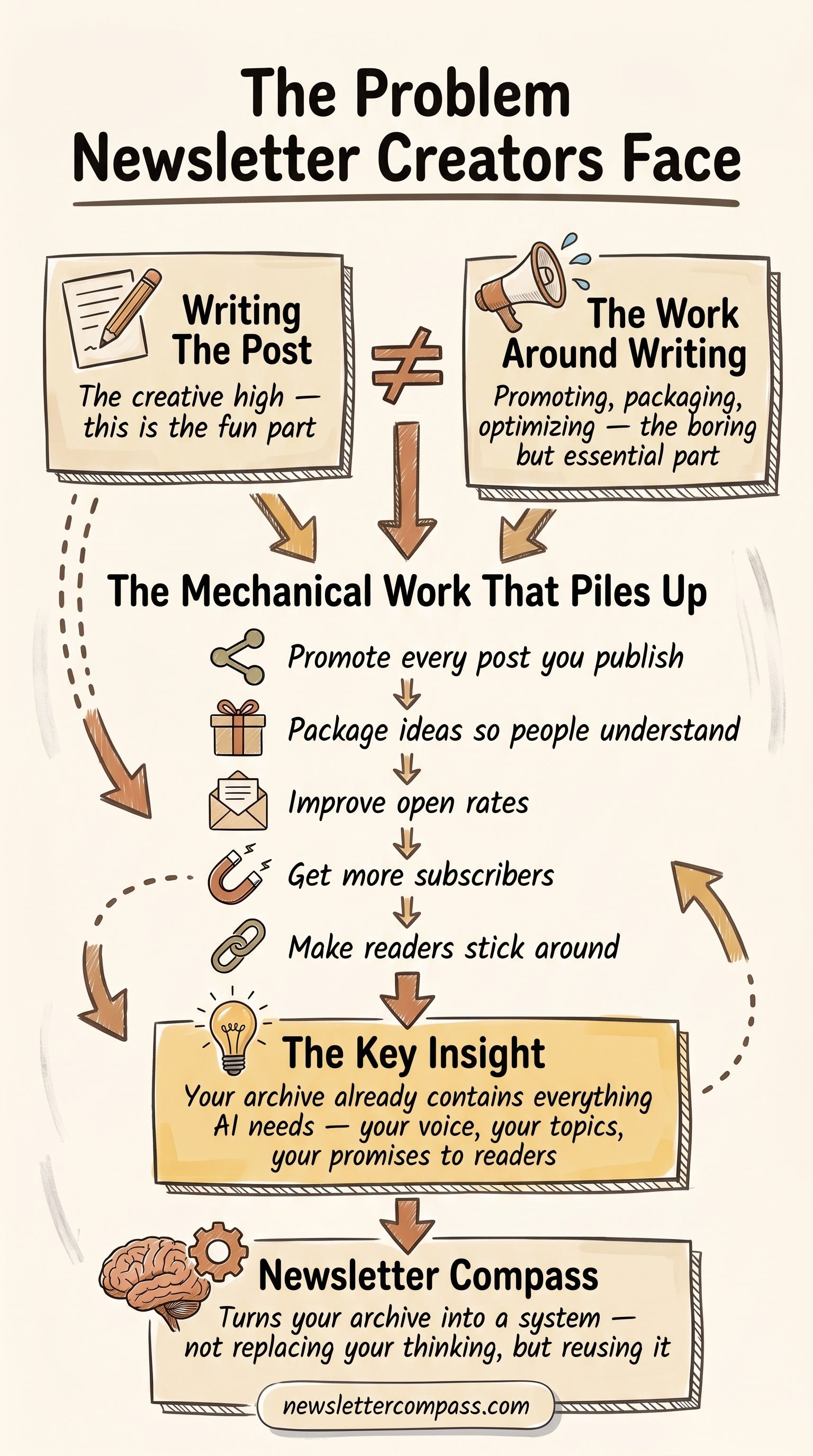
Most newsletter creators I know do not only struggle with “writing more.”
Instead, what they struggle are with the work around writing.
You already wrote the post, but now you need to promote it. You already have a good idea, but now you need to package it in a way people understand. You already have readers, but now you need to improve the little things that affect whether more people open, subscribe, share, and stick around.
That work can feel boring because it is not the creative high of writing the essay. But if you care about growing a newsletter, it is part of the job.
This is where I think AI can be useful in a very practical way. It can help turn the mechanical parts of newsletter growth into a system. Not a system that replaces your thinking, but one that helps you reuse the thinking you already did.
That last part matters.
Because if you have been writing for a while, your archive already contains a lot of useful information. It shows what you care about. It shows how you explain things. It shows what topics you return to, what language you use, what promises you make to readers, and what kind of relationship you are building with them.
Newsletter Compass uses that archive as part of the product.
What Newsletter Compass Does Right Now
Some of you might have received my first announcement about Newsletter Compass back in March. Since then, the product has become more complete. It is still early, and I am still building, but the direction is clearer now:
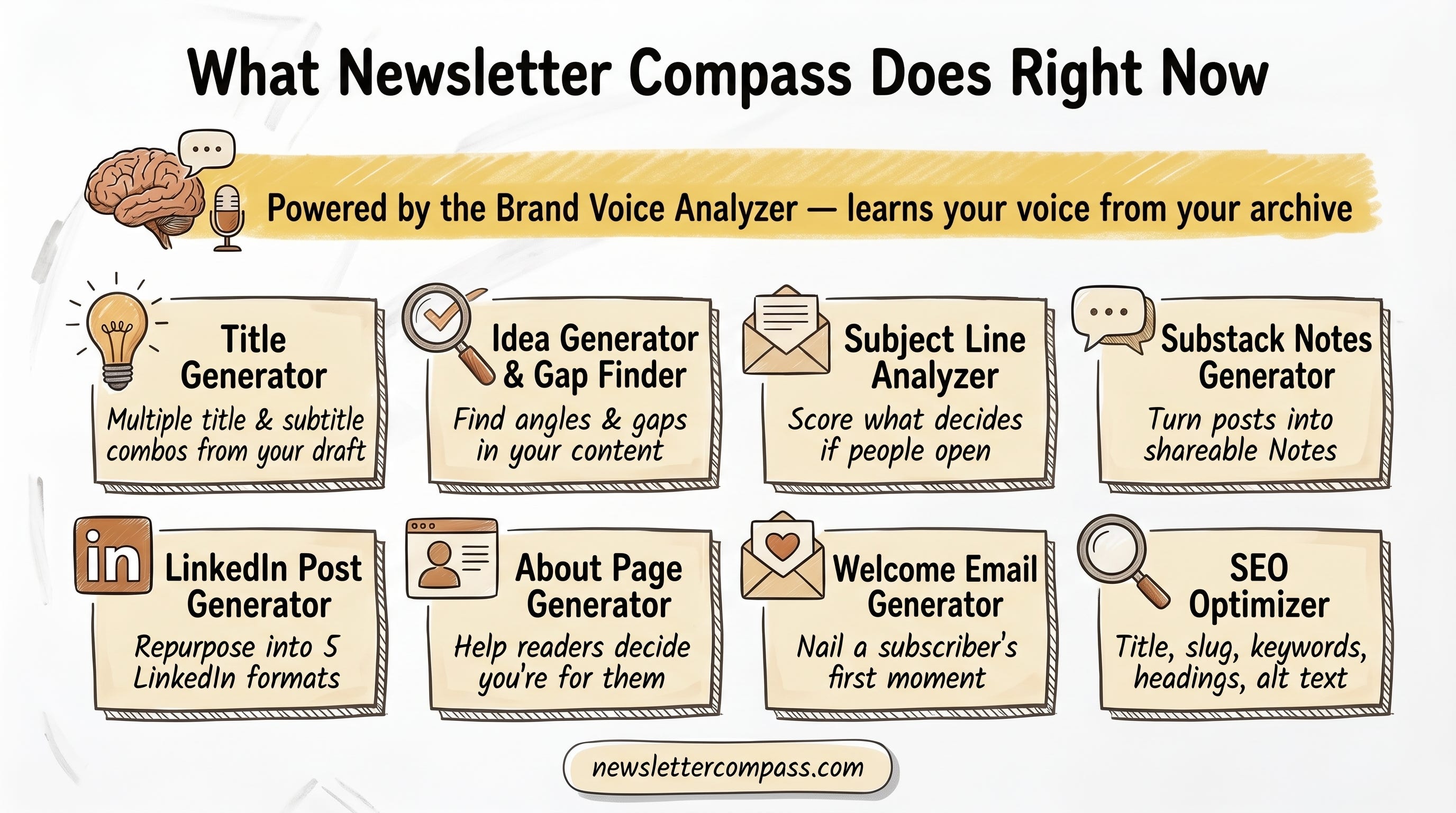
Brand Voice Analyzer: This is the foundation. It looks at your existing writing and turns it into a usable profile, so the assets around your newsletter do not sound disconnected from the newsletter itself. It works best when you already have an archive, because the tool needs real examples of your writing to understand your voice, audience, topics, and positioning.
Title Generator: Titles are small, but they can steal a ridiculous amount of time. The Title Generator gives you multiple title and subtitle combinations based on your draft, so you are not staring at the post after finishing it and trying to name it from scratch.
Idea Generator & Gap Finder: This helps you find angles worth exploring and gaps in your existing content. Sometimes the problem is not that you have no ideas. It is that you do not know which part of your archive needs a next step, a beginner version, a deeper version, or a different format.
Subject Line Analyzer: This helps improve the thing that decides whether people open the email. It scores subject lines across clarity, engagement, emotional appeal, and technical factors, then gives recommendations and alternatives.
Substack Notes Generator: This takes an existing newsletter post and turns it into multiple Note angles. The goal is not to create random content. The goal is to make it easier to share the thing you already wrote in a way that can reach new readers.
LinkedIn Post Generator: This turns a newsletter post into several LinkedIn-ready versions, including thought leadership, story-driven, tactical listicle, contrarian take, and engagement hook formats. Repurposing is one of those things everyone knows they should do, but it often feels like another writing task. This makes it more mechanical.
About Page Generator: Your About page is often where a new reader decides whether your newsletter is for them. This tool uses your brand profile and lets you choose a framework, like mission-driven, story-driven, credibility-driven, or conversion-driven.
Welcome Email Generator: The welcome email is one of the first real moments a reader has with your newsletter. This tool creates a welcome email based on your brand voice and a framework like personal story, authority welcome, quick win, or community builder.
SEO Optimizer: This focuses on the SEO basics you can actually edit in Substack: title, description, slug, keyword placement, heading structure, and image alt text. If you add a target keyword, it can also look at competitor results and suggest content gaps or keyword opportunities.
I am careful with SEO because I do not want newsletter writing to become search-engine-shaped writing. Discoverability still matters, though. So the goal is practical: improve the pieces you can edit without turning the post into something lifeless.
Who This Is For
This is the part I want to be clear about.
Newsletter Compass is not for first-time writers who want AI to write their first post.
If you have never written before, there is no real archive for the tool to learn from. There is no clear voice to analyze yet. There are no patterns in your topics, audience, or positioning. At that stage, the better move is probably to write more and build a small body of work first.
Newsletter Compass becomes more useful once you already have some writing behind you.
It is for the creator who has been publishing for a while and wants to grow further or faster.
It is for the person who writes the newsletter, then avoids the promotion layer because turning the post into Notes or LinkedIn posts feels like extra homework.
It is for the writer who knows the About page and welcome email matter, but keeps postponing them because they feel like mechanical setup tasks.
That distinction is important to me.
Newsletter Compass is not trying to replace the writer. It is software for the growth layer around the writing.
The taste still has to come from you.
The archive still has to come from you.
The point of view still has to come from you.
Newsletter Compass helps you use those things better.
Why I Am Sharing This With You
I am sharing this here because AI Maker is the reason the product exists. Writing this newsletter taught me where the friction actually lives: choosing the idea, naming the post, sending the email, sharing the post, welcoming new readers, and keeping your voice consistent across all of it.
That whole chain is the work.
For a long time, I treated each part as a separate task. Now I think the better version is a connected growth system around the newsletter. A system that remembers enough about your work to help you move through the repeated parts with less friction.
That is what I am trying to build with Newsletter Compass.
It is early. Some features are already useful. Some still need more testing. Some parts will probably change after more creators use it and tell me what feels clunky. I am okay with that. I would rather build this with people who are in the weekly reality of newsletter creation than polish it quietly and guess what matters.
If You Want To Try It
You can try Newsletter Compass here:
There is a 7-day free trial, and plans start at $20/month or $120/year after the trial.
🎁 As a thank-you for being early and helping me improve it, you can use code WELCOME for 50% off for life.
If you try it, I would genuinely love feedback. What worked? What felt clunky? What did you expect it to do that it does not do yet? What would make it useful enough to become part of your weekly growth process?
You can use the contact form in the footer of the site. Right now that feedback is more useful than almost anything else.
I am still building this in public. I am saying this is the most direct version of what I keep writing about in AI Maker: build systems around the work you actually do. Newsletter Compass is my attempt to do that for newsletter creators who are already writing and want the rest of the growth work to feel less scattered.
Best,
Wyndo
P.S. You do not have to buy anything to be helpful. Even trying the free trial and telling me, “this part confused me,” or “I expected this feature to work differently,” would genuinely help.
 | A guest post by
|
Loved working on this with you!