



When people talk about AEO (Answer Engine Optimization), the advice usually sounds familiar: add an FAQ, answer the question clearly, use useful headings, include a comparison table.
All of that can help. AI answers need information they can understand and pull into a response.
But I kept getting stuck on a more basic question: how do you know what information an AI answer actually needs from you?
Because here are some problems you might face, even if you’ve implemented a proper AEO framework:
You can add five FAQs to a post and still repeat what every other blog already says
You can write a clean comparison table that gives readers nothing new
You can spend hours polishing a page without knowing which questions, sources, or missing details matter around the topic
That is why I found Dheeraj Sharma’s AEO agent interesting in Episode 18 of One Shot Show. It runs deep research before the writing starts. The agent looks at the questions around a topic, the sources already appearing around those questions, and the gaps those sources leave behind.

The output is 10x better than a typical content brief. It tells you what people are trying to decide, what information is already easy to find, and what kind of evidence could make a new post useful.
The agent cannot promise a citation. No one can honestly promise that. Google, Anthropic, and OpenAI do not publish a fixed formula for which page appears in every AI answer. But if you’re not sure what topic to write about next or what value you should offer in your content, this can be a way to stop guessing and start making more informed decisions about what to publish next.
What Is Answer Engine Optimization (AEO) Trying to Do?
AEO is about helping your work show up when someone asks an AI tool a real question.
Someone might ask Google AI Mode how long a Spiti Valley road trip should take. They might ask ChatGPT which research tool is worth paying for, or ask Perplexity how to compare two smartphones before buying.
If the answer includes a link to your post, you have a chance to be discovered at the moment the person is looking for help. This can be a goldmine if you are running a blog, newsletter, product site, or business. It does not guarantee a click, a sale, or even a stable source position. But, at least it gives your work another path to reach the right reader.
Google’s own documentation explains that AI Overviews and AI Mode can break a complex question into related searches, then find supporting pages as the answer is being generated. Google calls this query fan-out. The source mix can shift because the question and its sub-questions shift.
ChatGPT Search describes a similar process: it can rewrite a user’s question into targeted searches, review the early results, and run more specific searches when the answer needs them. Read OpenAI’s explanation.
That makes AEO more than a checklist for a single page, because you are trying to make your content useful enough to support a real answer.
How an AEO Content Strategy Usually Starts
These are how most people try to improve AEO on their websites and blogs:
Put the direct answer near the top of the page
Use clear headings that match the question someone would ask
Add FAQs when they cover a real follow-up question
Use tables, comparisons, steps, and examples when they make a decision easier
Keep facts updated and make the original source easy to find
These practices help a reader as much as they help a search system. Google says there is no special AEO markup or extra technical requirement for AI Overviews and AI Mode. Existing search fundamentals through SEO framework still apply, including accessible text, a crawlable page, and helpful, people-first content. Google’s guidance is worth reading in full.
The problem is that page structure alone cannot guarantee that you provide useful content to your audience. That’s why the hard part happens before you format the page. You have to find the unanswered question, missing evidence, or decision that the current content still does not handle well.
The AEO Content Research Workflow
This is the job Dheeraj designed the agent to do.
It starts with a topic, then runs a research process that looks roughly like this:
Map the question. Find the core question, related questions, and the language people use when they are trying to make a decision.
Map the source landscape. Review the pages, sources, and answer formats already appearing around those questions.
Find the gap. Separate what is already well covered from what is vague, outdated, overly commercial, unsupported, or missing entirely.
Decide what evidence would help. Recommend the information the next post needs: a firsthand account, a current cost, a comparison, a decision table, a case study, or a direct answer to a narrow question.
Create the content from real material. The writer still has to do the work, check the facts, and decide whether they have a truthful contribution to make.
The most important thing here is to let the agent run research while you, the writer or human, create the content.
What We Saw in the Spiti Valley Demo
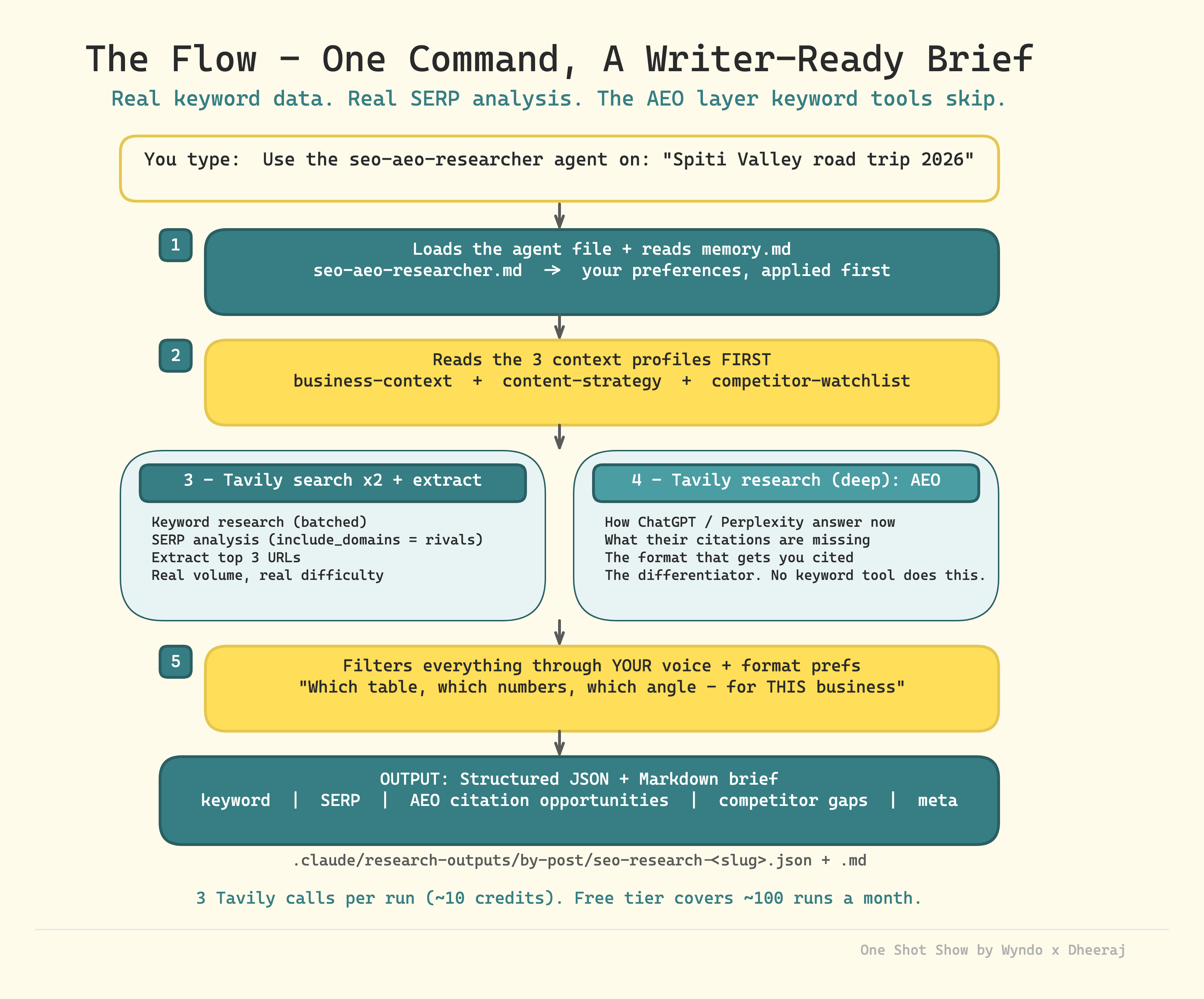
Dheeraj used a hypothetical Spiti Valley bike-trip article to show the process live.
The SEO side returned familiar material: keywords, ranking pages, common questions, and possible angles. The AEO side tried to answer a different set of questions:
What are people asking AI tools about this trip?
What information is already being supplied by the sources around those questions?
Which details are missing from the current answer?
What format would make those missing details clearer?
The output surfaced questions such as how many days the trip takes, whether it is safe for beginners, which route to choose, which permits matter, and when to go. Then it suggested possible information gaps: a current self-drive cost table, a route comparison, and a decision table for seven-, nine-, and eleven-day trips.
All this information points to one thing: it creates value for a creator with real trip experience, because they can publish the actual costs, road conditions, route tradeoffs, and decisions that only became clear during the trip.
That would be more useful to a reader. It also gives an answer engine a more specific source to draw from.
The same pattern transfers to almost any topic:
A consultant who helps SaaS teams improve onboarding wants to appear when a founder asks why trial users are not activating after sign-up. The research agent finds plenty of broad onboarding advice, but little help for a small team trying to diagnose drop-offs without a large analytics setup. The consultant can publish a practical diagnostic that shows the three signals to check and when each one points to a different fix.
A software builder who sells ecommerce reporting tools wants to appear when a store owner asks why sales reports do not match their payment data. The research shows generic explanations of reporting errors, while the real gap is a clear way to trace where numbers diverge. The builder can create a guide that walks through the exact checks their customers use before trusting a report.
A creator who builds Notion project-management templates wants to appear when a project manager asks how to track client work, deadlines, and blocked tasks without building a huge system. The research agent maps the answers and template pages already covering that question, then identifies what they leave out. The creator can build a page that demonstrates the exact template view for that problem, who it is for, and how it works in a real project.
A small agency owner who manages several client projects wants to appear when a founder asks how to stop client approvals from delaying every campaign. The research shows generic project-management advice, but few examples show a simple approval system for a two- or three-person team. The owner can publish the checklist, timeline, and handoff rules they use with real clients.
None of these require you to do something dramatic or complex. You just have to care enough about your niche or business that comes from contact with the actual work.
What We Are Building: A Claude Code AEO Research Agent
You’ll learn how to build an AEO Research Agent that turns the entire process into a repeatable research system. You give the agent a topic. It researches the current question and source landscape, then returns an AEO content brief before you write.
The brief includes:
The main question and related questions people are asking
Current sources and formats showing up around the topic
What those sources answer well
The gaps, weak evidence, stale details, and unanswered decisions worth investigating
The source material you need before writing
A recommended content format for carrying that material
By following these frameworks, you’ll be able to generate grounded, useful content that actually solves real problems people are asking about—and is unique enough that other sources haven’t covered it yet.
The agent helps you choose the evidence and format before you start drafting.
Build Your Folder Through an Onboarding Conversation
At the end of this post, I’m sharing your a Claude Code starter kit.
What you need to do is simply open the folder in Claude Code and run the included /onboard-aeo command. It interviews you about your audience, firsthand experience, existing content, competitors, writing preferences, and the claims you do not want the agent to make.
Then it shows you a short summary for approval. Once you approve it, the command writes the right context files into the visible context/ folder:


