

How I Built an AI Board Advisors That Pressure-Tests Every Big Decision
CEO, CTO, CFO, Operator, and Critic — all in one place.


A few weeks ago, I had a business question sitting in my head that I kept circling:
“How do I grow revenue over the next six months without making the business heavier?”
That sounds like a simple question until you actually have to answer it.
The easy AI version is to paste the question into one chat and ask for a plan. I did that too. The answer was reasonable. It gave me a few options, named the upside, mentioned some risks, and made every path sound possible.
That was the problem.
When every option sounds reasonable, I don’t actually feel closer to a decision; I just end up with a cleaner-looking version of something I’m still unsure about.
Around the same time, I asked my paid readers what they wanted me to write next. One reader asked if they could build an AI advisory board for business decisions. Something that could help them understand risk, spot opportunities, and decide what to do next.
I liked the question because I already had a rough version of that.
Whenever I have a business idea I’m not sure about, I run it through my AI board. I still make the final decision, but the board helps because I make better choices when the question gets pulled apart from a few different directions before I choose.
These are some of the questions I often ask:
How do I improve my paid subscriber rate by 50% over the next six months with a limited budget?
How do I increase revenue without adding a lot of new cost or recurring work?
If I want to grow, what should I build from the assets I already have?
The revenue question is the one that stuck with me.
Because one of the board’s recommendations was to build a cohort.
That is basically what I have been building.
💡 A quick note from me…
AI chat has a ceiling. You re-explain the project, re-upload the files, repeat the same corrections. Agentic Academy is 10 live weeks where you build one AI system that runs your real work. No coding. Starts June 22. Enroll now.
I do not want to overstate this. The board did not magically invent the cohort for me. The idea was already floating around, and there were still a lot of human decisions after that.
But the board helped me see why the cohort fit better than a few other options:
The CEO lens liked it because it built from the audience and trust I already had.
The CFO lens liked that it could create meaningful revenue without requiring a large ad budget.
The operator lens pushed back because live delivery could become heavy if I designed it badly.
The critic asked whether I was building a real business asset or just creating another weekly obligation for myself.
That last question was important to think about deeply.
Because I work mostly alone, a good revenue idea cannot only look good on paper. It has to fit the way I actually work. It has to build from what I already have: my subscribers, my writing, my paid archive, my agent-building skill, and the problems readers already ask me about.
That is where a normal AI answer often breaks for me.
If I ask a generic chat how to grow revenue, it might suggest ads, more products, sales calls, partnerships, posts, and more everything.
Some of that advice might be useful. But a lot of it ignores the actual shape of my business.
The Problem With One Polished Answer
Most people use AI for business decisions by asking one general chat for advice.
I do this too.
You paste in the question, add a little background, and ask something like, “What should I do?”
The answer usually sounds helpful. It names the upside and the risk, and it gives you a plan. Sometimes it even says, “Here is the balanced recommendation.”
But one chat is trying to be the strategist, finance person, technical person, operator, and skeptical reviewer at the same time.
The roles start blending together.
The finance view drifts into brand strategy. The operator creates a plan before the tradeoff is clear. The critic gives generic warnings. The final answer feels complete, but it may never force the decision through the lens that actually matters.
How To Give Each AI Advisor A Specific Job
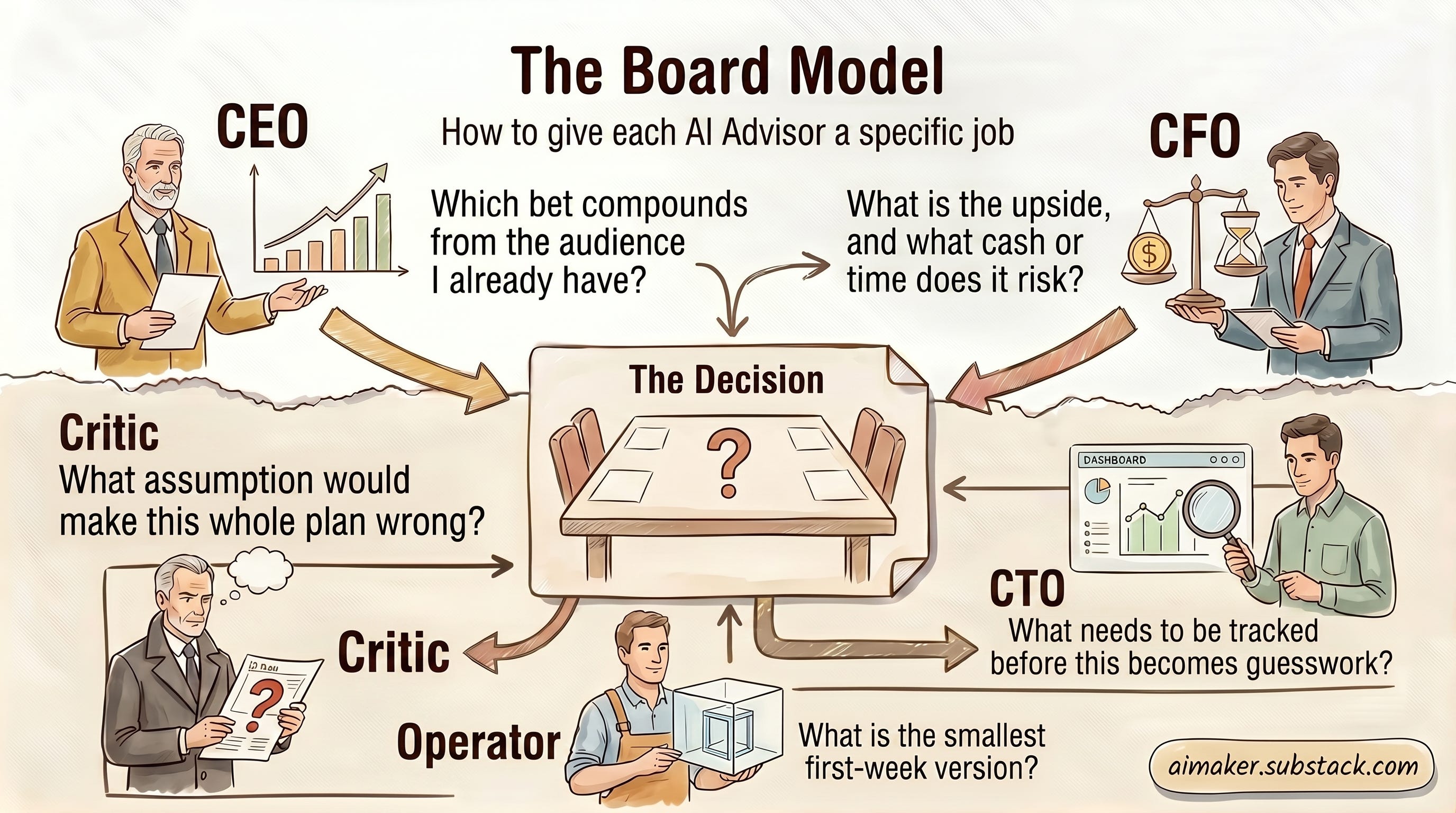
The useful shift was giving each advisor a specific job.
For the revenue question, instead of hearing five different voices telling me to chase growth at all costs, I needed each lens to ask a different kind of question:
CEO: Which bet compounds from the audience I already have?
CFO: What is the upside, and what cash or time does it risk?
CTO: What needs to be tracked before this becomes guesswork?
Operator: What is the smallest first-week version?
Critic: What assumption would make this whole plan wrong?
That is the board model.
If the CEO and CFO both give the same broad strategy advice, the board fails. If the critic only says “be careful,” the board fails. If the operator starts making a 90-day plan before the decision is clear, the board fails.
Each role needs a job.
The CEO helps choose the bet. The CFO makes the cost and risk visible. The CTO checks whether the idea can be built or tracked without becoming fragile. The operator turns the decision into a real sequence. The critic finds the assumption I am most likely to skip.
Then I decide.
The board supports judgment. It does not replace it.
Why Context Matters More Than The Persona
After running this a few times, my honest take is that the AI advisor can work.
You can make the model act like a CEO, CFO, CTO, operator, or critic. That part is relatively easy.
The harder part is giving those advisors enough real context to judge anything well.
Without that, the board becomes five polished generic answers. The CEO gives business-school strategy. The CFO talks about margins with no actual numbers. The operator proposes work that assumes a team you do not have. The critic warns about risk without knowing which risks actually matter to your business.
This is where context changes everything.
For AI Maker, that means the board knows things like:
I mostly work alone.
My business runs through the newsletter, paid posts, consulting, and occasional digital products.
My strongest asset is the audience I already have.
I care about personal brand, content systems, agent builds, and practical AI workflows.
I do not want growth that breaks trust with readers.
Those facts give each advisor something to push against.
The advice becomes more conditional and more useful.
It can say: this idea fits because it builds from the audience you already have. Or, this might work financially because it does not require a large upfront ad budget.
That is very different from a generic growth plan.
It helps me make better decisions based on my current business conditions and priorities. That’s the most important part.
When I Would Use This
I would use this for any decision where the answer sounds simple until you have to live with it.
For example:
Should I launch this product now or wait?
Should I change pricing?
Should I spend money on ads?
Should I hire help or stay solo?
Should I build a new offer from scratch or use the audience and skills I already have?
The board will not make the decision easy. Trust me, you will still need to make hard decisions after the agent analysis. But at least it can make the decision cleaner so you understand the real trade-offs and what you can expect from each decision you make.
That is what I wanted from it.
What This Gives You
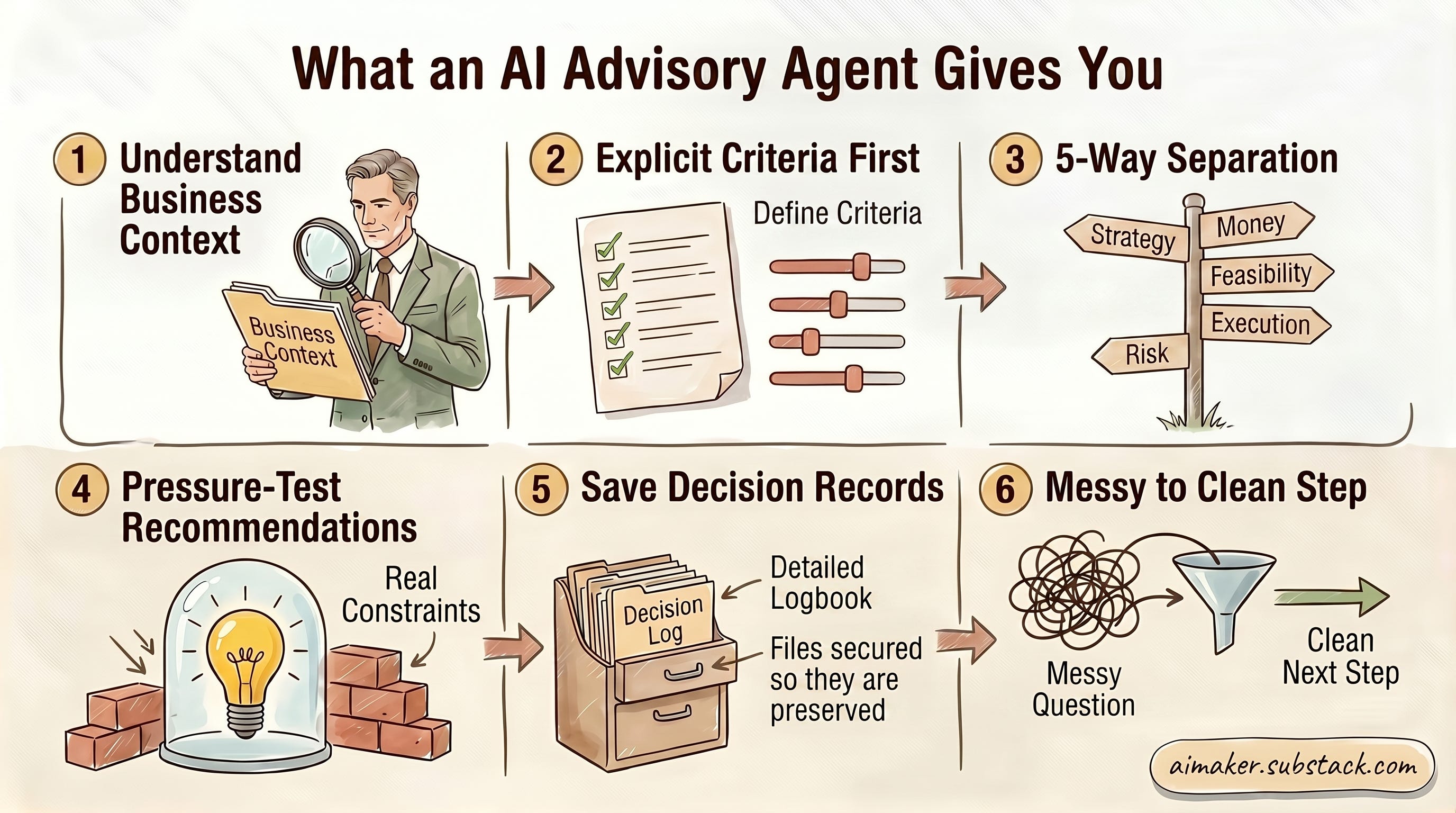
If you build this for your own work, you can turn hard decisions easier to process.
You give the agent enough business context to understand your situation. You define the criteria that matter before the advice starts. You ask separate advisors to look at the same decision from different angles. Then you turn the result into a saved decision log, so the reasoning does not disappear three days later.
That is the productivity gain I care about here.
By the end, you should have a board that can help you:
Understand the business context behind the decision.
Make the decision criteria explicit before the answer arrives.
Separate strategy, money, feasibility, execution, and risk.
Pressure-test the recommendation against your real constraints.
Save the decision record so you can review it later.
Turn a messy business question into a cleaner next step.
What We Are Building: AI Advisory Board
The thing we are building is a small decision system. It starts with one messy business question.
Something like:
How do I grow revenue over the next six months without making the business heavier?Then it turns that question into a process.
First, the board creates a decision intake. This is where the vague question becomes more specific: what decision are we actually making, what options are on the table, what constraints matter, what evidence do we have, and what would make the decision wrong?
Then the board sends that same decision to separate advisors.
The CEO looks at direction and focus. The CFO looks at money, risk, and upside. The CTO looks at feasibility and tracking. The operator looks at sequence and capacity. The critic comes in after the first round and asks what everyone might be missing.
After that, the chair pulls the views together, completes a scorecard, and saves the decision log.
The flow looks like this:
Question in
Decision intake created
CEO, CFO, CTO, and operator review the decision separately
Critic reviews the first four memos
Chair synthesizes the board
Scorecard completed
Decision log saved
Next actions listed
If you run this often enough, it becomes a useful habit: one place to think through hard decisions, one process for separating the angles, and one saved record you can review instead of rebuilding the same context every time.
Now, let’s dive in.
🚨 Before continuing, this post is part of my agent series where I share how to build your own agent using Claude Code or Codex as the primary tools. If this is your first time using any of these tools, you might want to read my Claude Code for beginners posts before continuing with the rest of this one. Here are some relevant posts to get started:
How I Turned Claude Code Into My Personal AI Agent Operating System for Writing and Research
The Complete Guide to Build Your Personal AI Operating System With Claude Code
From Blank Folder to Working System: How to Set Up Any Project in Claude Code
Make sure you’ve mastered the basics before reading the rest of this post. I’m also sharing a video walkthrough so you can see how to run the AI Advisory Boards more clearly.
1. The Project Files
Same as my other agent guides, we are building this in a local computer folder that you can use within your Claude Code setup.
Here is the folder we are going to build.
Do not worry if this looks like a lot at first. We will have an interview process that can help you fill all these files easily.
But the whole structure is doing a simple job:
context/tells the board what your business is.criteria/tells the board how to judge the decision.templates/gives the board a consistent shape for intake, review, and logging..claude/agents/holds the advisor instructions..claude/commands/gives you one command to run the whole process.decisions/andruns/save what happened so the decision does not disappear.