



For Episode 5 of One Shot Show, Dheeraj Sharma and I sat down to answer the question I keep seeing in DMs, group chats, and comment sections: did Anthropic just kill OpenClaw with Claude Code channels?
It’s a fair question. Channels dropped a few weeks ago. Anthropic also banned the OpenClaw harness from running on their subscriptions last week. And suddenly the whole OpenClaw community started rethinking their setup.

So we ran both tools live on the stream. Dheeraj demoed Claude Code channels with a Telegram integration in under 30 minutes. We also walked through what it takes to get OpenClaw running, drawing from my own setup and Dheeraj’s experience deploying it to a server. Then we scored both across eight categories and tried to give you a real answer.
Here’s the short version: no, Anthropic didn’t kill OpenClaw. But they’re clearly walking in that direction, and the gap is closing faster than I expected. What actually matters is that these two tools solve different philosophies of autonomy, and figuring out which philosophy fits your workflow is the real decision.
Why Anthropic vs OpenClaw Matters Right Now
If you’ve been anywhere near the AI agent conversation lately, you’ve probably heard both names.
OpenClaw is the open source project that exploded in popularity because it let you run Claude autonomously on your own machine. You could give it a personality through config files like SOUL.md and USER.md. You could set up a heartbeat so it would monitor your email every hour or check your Notion to-do list at 2 a.m. without you touching it. People started building 24/7 AI employees on top of it.
Claude Code is Anthropic’s official CLI. Until a few weeks ago, it was mostly an AI agent you ran in your terminal. Then Anthropic started shipping new connection features. First remote control. Then dispatch. And now channels, which lets you connect Claude Code to Telegram, Discord, and iMessage through plugins so you can talk to your projects from your phone.
Read the full Anthropic updates for Q1 2026 right below 👇

So the surface-level question is: if Claude Code now lets me chat with my projects from Telegram, do I still need OpenClaw?
And the answer we landed on is more interesting than yes or no.
🚨 Quick reminder…
AI Maker Lab pricing goes up this Thursday, 4/16. If you’ve been curious about the implementation blueprints to build your AI agent, you have 5 days left to join at $10/month before it moves to $15. You can learn more details here.
The Setup Tax Tells You Half the Story
Before the philosophical stuff, let me talk about what it actually feels like to get these running.
I set up OpenClaw back in February. Hands-on time for me was around two to three hours. Reading the docs, picking a server, walking through onboarding, connecting my Anthropic subscription, and getting it paired with Telegram. Not insane, but enough that I had to block out a real chunk of time on a weekend to get through it.
Dheeraj’s experience was rougher. He told the story on stream: his OpenClaw setup ended up taking around two days because his first cloud server attempt failed and he had to move everything to a different host. Once he was on the second server, things worked, but the failed attempt cost him a full day of debugging.
Then he pulled up Claude Code channels live during the stream and the contrast was immediate. He opened a Claude Code project, installed the Telegram plugin through the marketplace, made sure he had BUN installed, ran claude --channels plugin:telegram, created a bot through BotFather, and paired it to his session. The whole thing ran in under five minutes on camera.
We both agreed: if you already have Claude Code on your machine, channels setup is hardly anything. Under 30 minutes even if it’s your first time.
For a non-technical person, the real gap is the decision. If the initial setup makes you question whether it’s worth it, you’ll never get to the interesting part. And if you don’t want to spend time on the setup process, I don’t think you’ll want to maintain and improve it.
That’s the first half of the story. But setup ease alone doesn’t tell you why someone would still want OpenClaw.
Event-Driven vs Self-Driven: The Real Split
Here’s what clicked for me about halfway through the session.
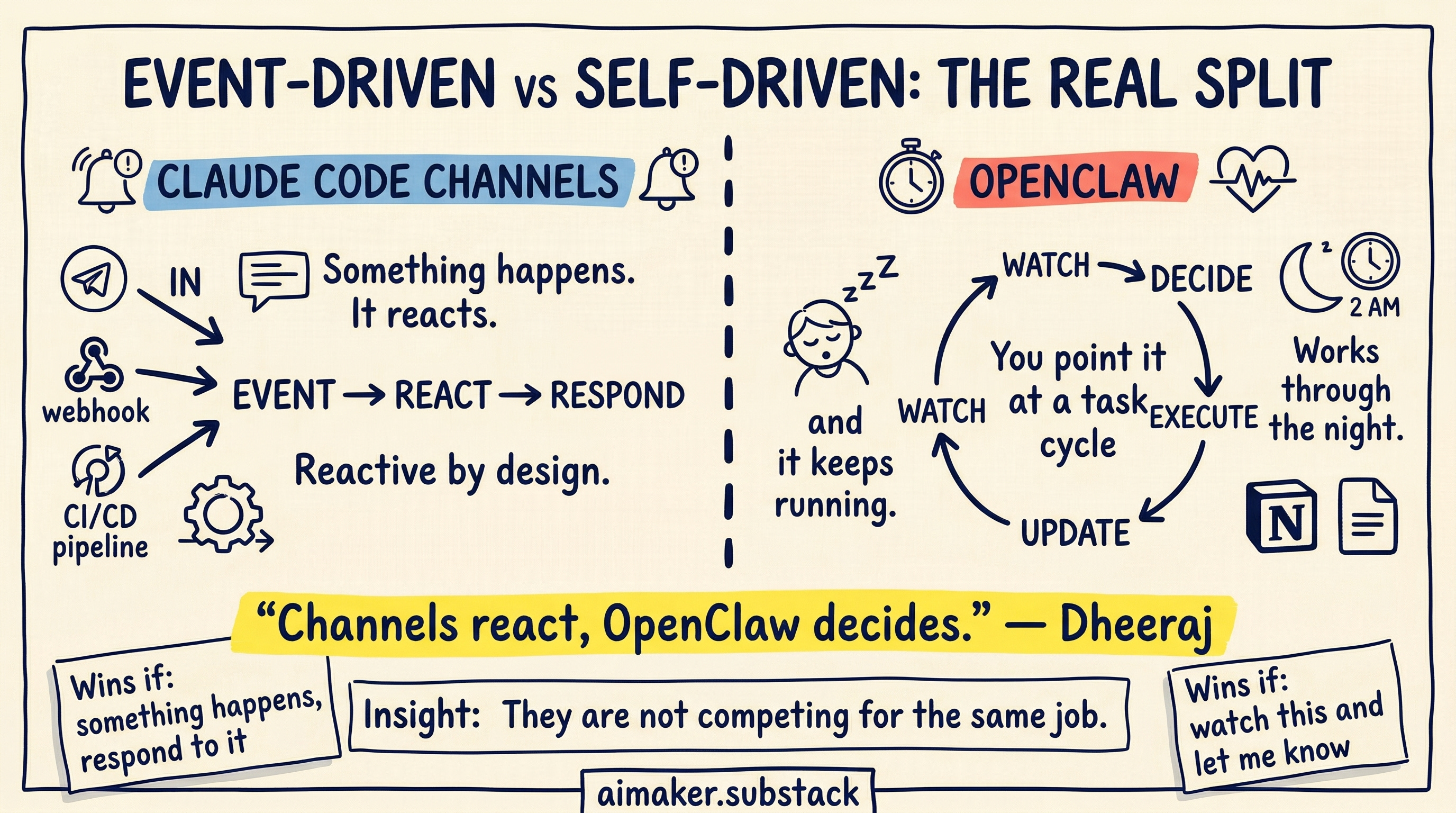
Claude Code channels is fundamentally event-driven. Something happens. It reacts. You send a Telegram message asking about yesterday’s job and Claude Code picks it up inside the project context you opened. A CI/CD (Continuous Integration/Continuous Delivery) pipeline fires a webhook. Your channel responds. It’s reactive by design.
OpenClaw is self-driven. You point it at a task and it keeps running. The heartbeat feature lets it check your inbox every hour on its own. My chief of staff agent in OpenClaw monitors my Notion to-do list every 2 a.m., picks up new tasks, executes them against Google Docs or Google Slides, and updates me on the whole project state when I wake up. I’m not prompting it. It’s working through the night.
Dheeraj summed it up on stream: channels react, OpenClaw decides.
That’s the split. And once I saw it that way, the “did Anthropic kill OpenClaw” question stopped making sense. They’re not quite competing for the same job. Channels wins if your workflow is “something happens, respond to it.” OpenClaw wins if your workflow is “watch this and let me know.”
One quick caveat I should mention: Claude Code does have scheduled tasks as a separate feature, so you can get some cron-like behavior inside the Anthropic world. It overlaps with some of what OpenClaw’s heartbeat does, though it’s not the same as an agent that runs continuously with memory and project context. Anthropic is piecing together those capabilities across multiple features. OpenClaw gives it to you in one place.
The Honest Scoring
We scored both across eight categories during the stream. But the scores are less interesting than what we learned deciding them:
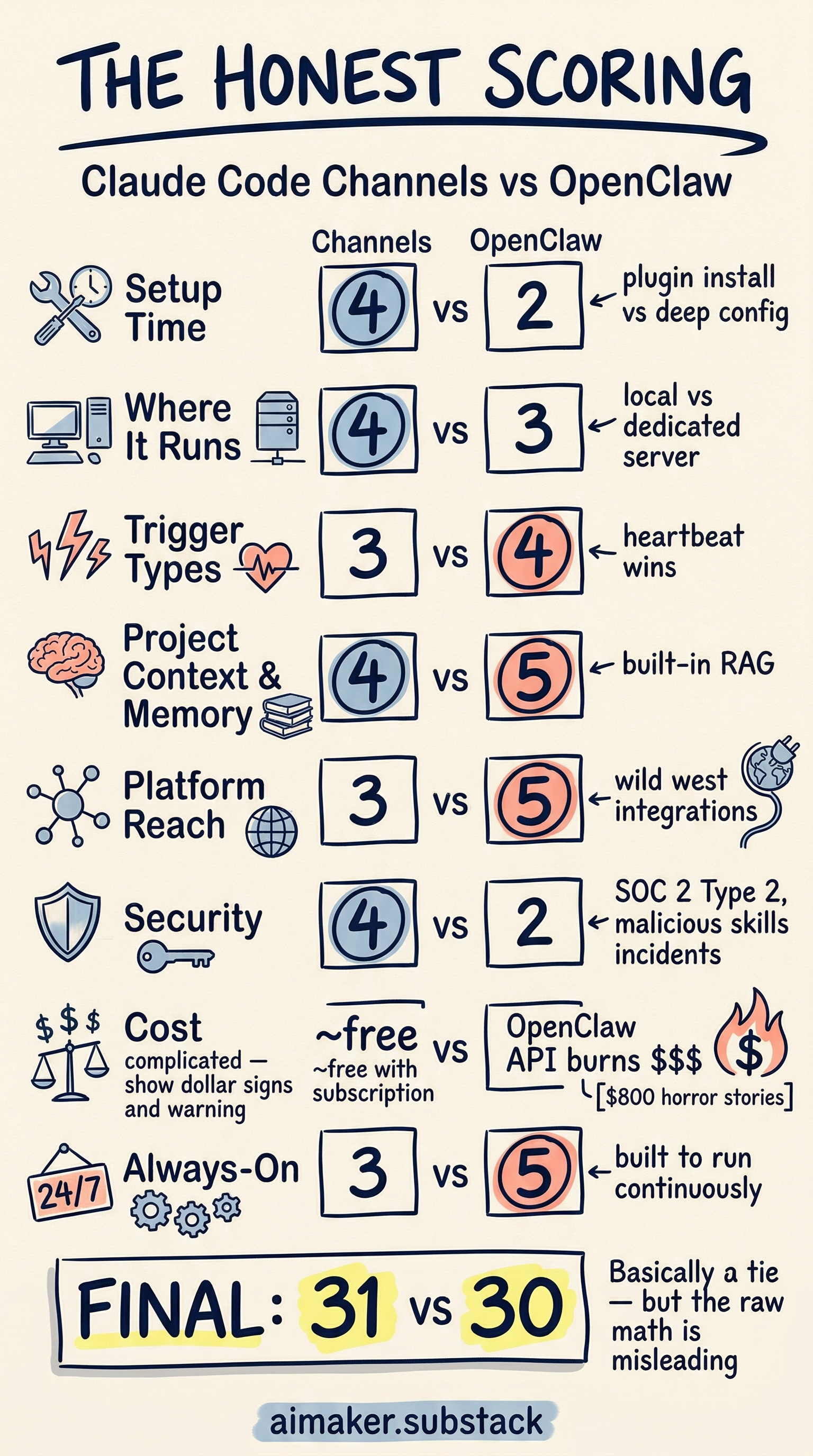
Setup time: Claude Code channels 4 / OpenClaw 2. Channels assumes you already have Claude Code running, so it’s basically installing a plugin. OpenClaw is a deeper configuration exercise, especially if you’re going cloud-hosted.
Where it runs: Claude Code channels 4 / OpenClaw 3. Channels keeps it local on your machine, which is both a strength and a limitation. OpenClaw is usually better on a dedicated server, which is more work but safer for always-on use.
Trigger types: Claude Code channels 3 / OpenClaw 4. OpenClaw wins because heartbeat lets it be both proactive and reactive. Channels is mostly reactive. Schedule tasks close some of the gap but not all of it.
Project context and memory: Claude Code channels 4 / OpenClaw 5. Both know your project. OpenClaw has built-in RAG and memory, so it references past conversations naturally. In Claude Code you can achieve similar things, but it takes manual work.
Platform reach: Claude Code channels 3 / OpenClaw 5. OpenClaw is wild west. It connects to Todoist, Notion, Obsidian with natural prompts like “hey, can you connect my Todoist” and it figures out where to ask for the API key. Channels supports Telegram, Discord, iMessage, and custom MCP webhooks, but connecting to new platforms still takes real configuration work.
Security: Claude Code channels 4 / OpenClaw 2. This is where staying inside Anthropic’s world really pays off. Read-only defaults, allow lists, plugin reviews, SOC 2 Type 2 certification. OpenClaw pushes the security burden onto you. If you ship a plain vanilla deployment, you’re in trouble. And OpenClaw’s community skills hub has had malicious skill incidents in the past, which is a real problem without a formal review process.
Cost: This one got complicated fast. If you already have a Claude subscription, channels is basically free. OpenClaw, after Anthropic banned the harness on subscriptions, now pushes you toward API costs or a secondary model like Kimi or Codex. API cost burns through money in seconds compared to the Max plan. I’ve seen horror stories of $800 bills from unmonitored OpenClaw instances. That’s the kind of cost that falls on you as the operator.
Always-on: Claude Code channels 3 / OpenClaw 5. OpenClaw wins by design because it’s built to run continuously. Channels needs your system on, which you can mostly solve with tmux to detach the session, but it’s still not the same as a dedicated cloud instance.
We ended at roughly 31 to 30. On the raw math, it’s a tie. But the raw math is misleading.
Two Things That Stood Out
1. OpenClaw’s Magic Was Always Anthropic Under the Hood
Here’s the thing I keep thinking about since the stream.
What made OpenClaw feel wild was Opus 4.6. The long-running autonomous tasks, the heartbeat monitoring, the whole “AI employee” vibe. All of that ran on Anthropic’s models. And Anthropic just banned the harness from working on subscriptions.
If you want to keep running OpenClaw now, you’re looking at paying for the Anthropic API directly, which gets expensive fast. Or moving to Codex, which as I said on stream, feels obedient rather than wild. Or falling back to a local model like Kimi, which is great for some tasks but not the same thing.
So the cost math for OpenClaw changed overnight. And it’s made me more cautious about building long-running agents on top of it. I don’t trust my budget to agents I haven’t monitored carefully, and I’ve seen too many horror stories in the community.
2. Anthropic Is Walking Toward OpenClaw’s Feature Set
If you zoom out from this single comparison and look at what Anthropic has shipped in the last three months, there’s a clear trend. Remote control. Dispatch. Channels. Scheduled tasks. They keep adding features that solve the same jobs OpenClaw was built for, one release at a time.
I think the direction is obvious. Anthropic wants people running agentic workflows inside their own tools, not through a third-party harness that costs them money every time someone spins up a long-running OpenClaw agent on a subscription plan.
And that’s probably why they banned the OpenClaw harness from subscriptions last week. Running OpenClaw at scale through a flat-rate subscription is expensive for any AI lab. Every long-running heartbeat, every overnight agent monitoring your inbox, every 24/7 AI employee running on Opus 4.6 burns compute that a $100/month plan was never priced to support. I think more bans are coming. Not because Anthropic hates OpenClaw, but because the economics don’t work if a big chunk of your user base routes through an open source harness you don’t control.
Here’s what makes this really interesting. OpenAI just acquired OpenClaw. Right now, Codex doesn’t feel as agentic as Opus. Codex is more obedient. It can do detailed tasks well, but it doesn’t have that wild, autonomous feel that made people fall in love with OpenClaw in the first place. But if people start feeling pushed out of the Anthropic world because of the harness ban, that’s a massive opening for OpenAI. If they can make Codex work naturally with OpenClaw, if they can match the feel that Opus gave it, they have a real shot at pulling the entire OpenClaw community over. I wouldn’t underestimate how much frustration with Anthropic’s bans could accelerate that shift.
So the bigger picture for me is this: the “did Anthropic kill OpenClaw” question is actually a proxy for a much larger battle. Both companies want to own the agentic layer. Anthropic is building it natively through features like channels and scheduled tasks. OpenAI is betting they can own it through an open source community they just bought. Both could work. But for us as users, it means this landscape is going to keep moving fast, and whatever setup you pick today will probably look different in six months.
So What Should You Actually Use
This is where we landed at the end of the session:
If you already live inside Anthropic’s tools and you’re non-technical: Stick with Claude Code channels. You don’t need to spin up a server. You don’t need to monitor API costs. You don’t need to manage security layers. Channels plus scheduled tasks covers most of what a knowledge worker actually needs, and setup is under 30 minutes. If 90 percent of your workflow is “talk to my projects from my phone and react to events,” this is the right answer.
If you want full autonomy and you’re comfortable with infrastructure: OpenClaw still wins for that specific job. The heartbeat feature, the built-in memory, the 24/7 monitoring, the easier platform connections. These are real advantages if you’re building an AI that runs while you sleep. But you’re taking on setup, security, and cost monitoring as your own responsibility. Go in with both eyes open.
If you want something in between: Look at Perplexity Computer or Manus. They came up in our Q&A as alternatives that sit between the two philosophies. I’ve tried Computer and it’s genuinely powerful because it orchestrates multiple models and has pre-built integrations with most apps. The cost structure is different though, since you’re paying for a wrapper that calls the underlying APIs. Worth testing, but probably not your first stop.
The deeper point is that this is a moment-in-time snapshot. Anthropic has shipped five different connection methods in the last few months. They’re walking toward OpenClaw’s feature set one release at a time. I wouldn’t be surprised if the next batch of updates closes more of the gap around always-on execution and memory. So whatever you pick today, plan for the tools to keep evolving underneath you.
What I’m Taking Away From This
Before the session, I half expected to walk out convinced one of these tools was dead.
What I walked out with is a clearer picture of why both still exist. OpenClaw has its magic in the wild west kind of autonomy. You can point it at a problem, give it a heartbeat, and let it work. That’s genuinely different from anything Anthropic ships natively today. But that same autonomy is also the reason you need to be careful with it, especially after the harness ban.
Claude Code channels doesn’t try to be that. It tries to be the simpler thing that most people actually need. Talk to your projects from your phone. React to events. Keep the security tight. Don’t make setup a two-day project. For a non-technical person, or anyone who doesn’t want to become a part-time sysadmin, that tradeoff is the right one.
So the answer to “did Anthropic kill OpenClaw” is no, not yet. But the split is real, the gap is closing, and if you’re picking a stack today, pick based on which philosophy fits how you actually work rather than which tool has the louder hype cycle.
Watch the Full Session
This was Episode 5 of One Shot Show, Season 1. We go live every Wednesday at 10:00 AM EST on Substack.
Here’s the season lineup:
Build a Content Research Agent with Claude Code(Episode 1)Google Opal vs n8n vs Make: Newsletter Repurposing Tool Audit(Episode 2)Substack Competitive Analysis Using Claude Cowork(Episode 3)n8n vs Claude Code & Cowork: Which Is Better?(Episode 4)Did Anthropic Kill OpenClaw? Claude Code Channels vs OpenClaw(this episode)How to Build Your First AI Agent on Notion - Guest: Anfernee
TBD
TBD
Watch the replay of Episode 5 [link to replay]
Jump to a specific section:
(00:00) Welcome and intro
(02:15) What is OpenClaw and why it exploded
(04:50) The solo.md, memory, and heartbeat features that define OpenClaw
(08:30) Anthropic’s connection methods: remote control, dispatch, channels
(10:15) How Claude Code channels work under the hood
(11:40) Live demo: Claude Code channels Telegram setup in under 5 minutes
(15:50) Why your system needs to stay on (and the tmux workaround)
(18:00) Where OpenClaw configuration gets complicated
(22:20) Scoring setup time: 4 to 2
(24:35) Where it runs: laptop vs server debate
(26:20) Trigger types and why heartbeat is second to none
(28:40) Project context and memory scoring
(30:05) Platform reach: why OpenClaw connects to Todoist and Notion easier
(32:45) Security posture deep dive and the community skills problem
(38:00) Cost picture and the Anthropic harness ban
(43:30) Always-on scoring and the tmux solution
(45:00) Final tally and why the scores don’t tell the full story
(46:30) Three workflows: CI/CD triage, morning briefs, inbox triage
(48:20) Final takeaway: OpenClaw decides, channels react
(50:40) Robert’s question: terminal feels like the dark ages
(52:35) Perplexity Comet, Manus, and other alternatives
(57:20) Closing thoughts
Resources Mentioned
Claude Code channels: Anthropic’s feature for connecting Claude Code sessions to chat platforms through plugins. Included with Claude subscription.
OpenClaw: Open source project for running autonomous Claude agents on your own infrastructure. Free to run, but requires API or subscription for the underlying model.
Claude Code: Anthropic’s official CLI. Works with subscriptions starting at $20/month (Pro) or $100/month (Max).
Opus 4.6: The Anthropic model that powered most of OpenClaw’s early traction.
Codex: OpenAI’s coding agent, mentioned as a possible replacement model for OpenClaw now that Anthropic banned the harness.
Kimi: Open source model some people are using as an alternative for OpenClaw.
BotFather: The Telegram tool for creating bots, used in the Claude Code channels setup.
BUN: Runtime utility required for Claude Code channels plugin setup.
tmux: Terminal utility for detaching sessions, used to keep Claude Code channels running without an open terminal window.
Hetzner Cloud: Where you can spin up a cheap always-on server for OpenClaw, starting around $4 to $5 per month.
Perplexity Computer: Alternative AI agent with multi-model orchestration and pre-built app integrations.
Manus: Alternative AI agent mentioned during the Q&A.


