



In Episode 21 of One Shot Show, Dheeraj Sharma and I built a content radar: an agent that scans the internet every morning, throws out almost everything it finds, scores what survives against your brand, checks it against what you have already published, and leaves you a five-minute brief.
Dheeraj drove this one. He has been running his version since May, so we were looking at something with three months of experimentation behind it. A lot of small mistakes, corrections, and lessons had already made their way into the files.
I went in expecting the interesting part to be the scan process. Which sources should it check? Which connectors should it use? How do you get Reddit results that are actually useful?
All of that was there, but it took only about ten minutes because the scanning is pretty straightforward now. The rest of the hour went into one file called the brand rubric, where you write down what a good idea is actually worth to you.
That file is where the agent begins to feel like yours. Without it, the agent can find plenty of ideas and still hand you the wrong ones.
🚨 This post is part of our agent series, where we show you how to build agents for different use cases. You can see the earlier builds here:
The Problem With How Most of Us Pick What to Write
Dheeraj opened with a question for the audience: how do you decide what to publish next? Gut feel every week? A backlog you are already behind on? A keyword tool? An actual system?
I answered honestly, because my version has three ways of doing it. I brain-dump any interesting ideas that catch my attention into Obsidian. I have a system that pulls summaries from the newsletters I subscribe to, which I run weekly and read manually. I have another one for X. Every week, all of that arrives, I look through it, and I pick whatever resonates most.
It works. But I still need to decide them myself, every time, from scratch.
And as the pile of ideas grows, it’s easy to feel overwhelmed. So many ideas, but no clear sense of which one to pursue. Dheeraj captured the real issue well: we do not lack ideas. We lack the signal that tells us which idea is the right one to write.
That gap is what the content radar is for—not generating more ideas, but ranking the ones the internet is already handing you.
What You Will Build: Content Radar Agent
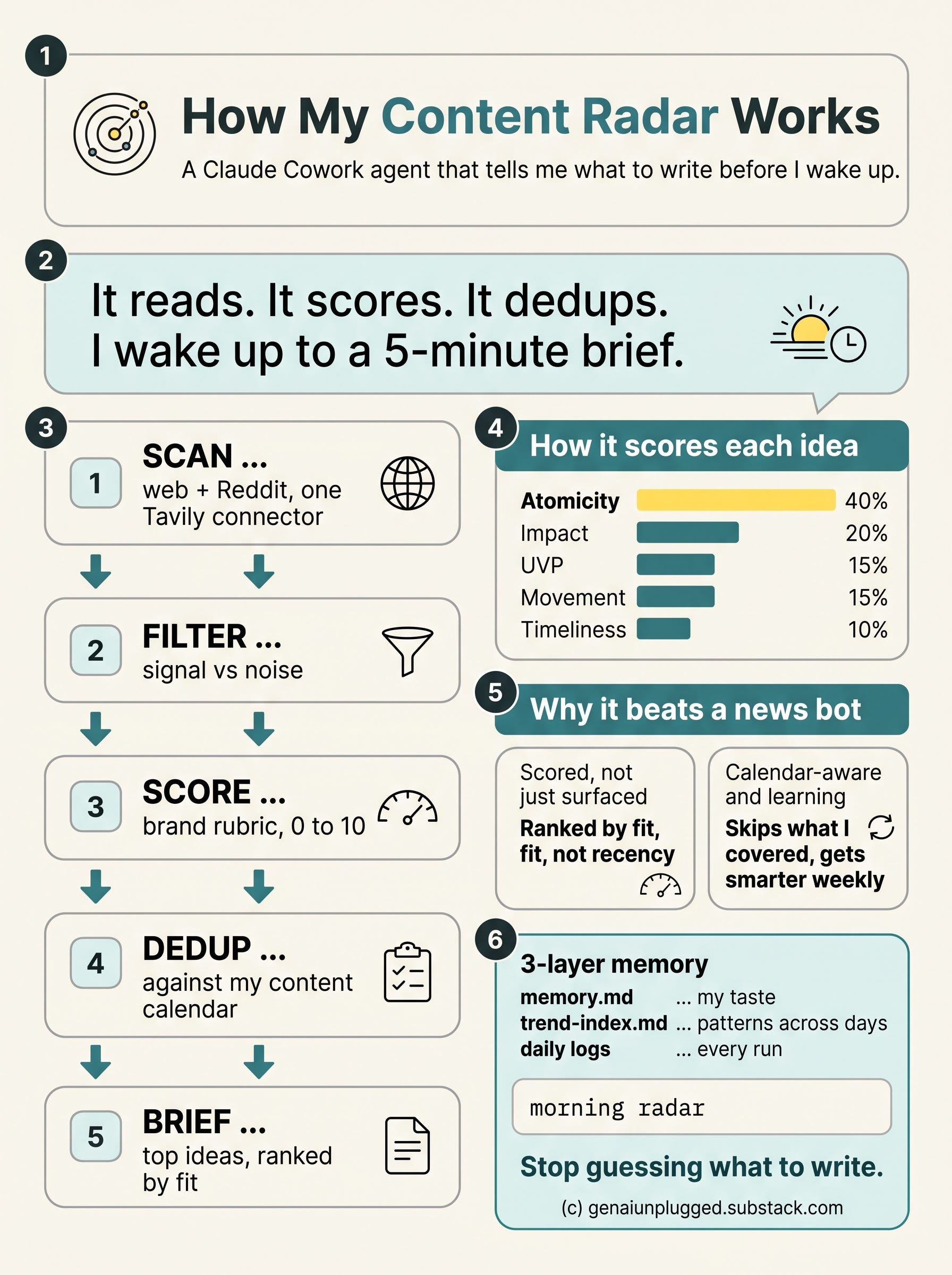
The rest of this post turns those decisions into a working content radar.
You will get the starter folder Dheeraj used, then work through the files that control what the radar scans, what it ignores, how it scores an idea, how it checks your existing calendar, and how it learns from your corrections.
By the end, you will have a version you can run manually in Claude Cowork or Claude Code or ChatGPT/Codex. Once the recommendations start feeling useful, you can schedule it and have the brief arrive even when you are away from your laptop.
The goal is simple: find a better list of content ideas that suits your brand and is relevant to you.
You might want to check Dheeraj’s Substack to explore more of what he writes about.

Let’s dive in.
Start With the Five Layers of Content Radar
To build your first content radar agent, there are five layers you need to know:


