

8 Lessons in 8 Months Growing My AI Substack from ZERO to $30K+ ARR and 9700+ Subscribers
Spilling everything, and I’d bet #5 will get bigger over time.


I remember April 2nd, the day I published the first AI Maker post. If you asked me why I started this newsletter, the answer was simple: I wanted to learn more about AI.
Science has proven that the best way to learn something is by teaching it to others. With this idea in mind, I created an expectation for myself that I needed to live up to.
This also forced me into a position where I had to walk the talk. I couldn’t share how I use AI if I wasn’t actually using it that way. I couldn’t write tips if I’d never done them myself. The newsletter became more than just a learning exercise, it became a public commitment that pushed me to explore AI deeper than I would have on my own.
Eight months later, over 9,700 readers have joined this newsletter, and I’ve accumulated $30k+ ARR since launching paid subscriptions four months ago.
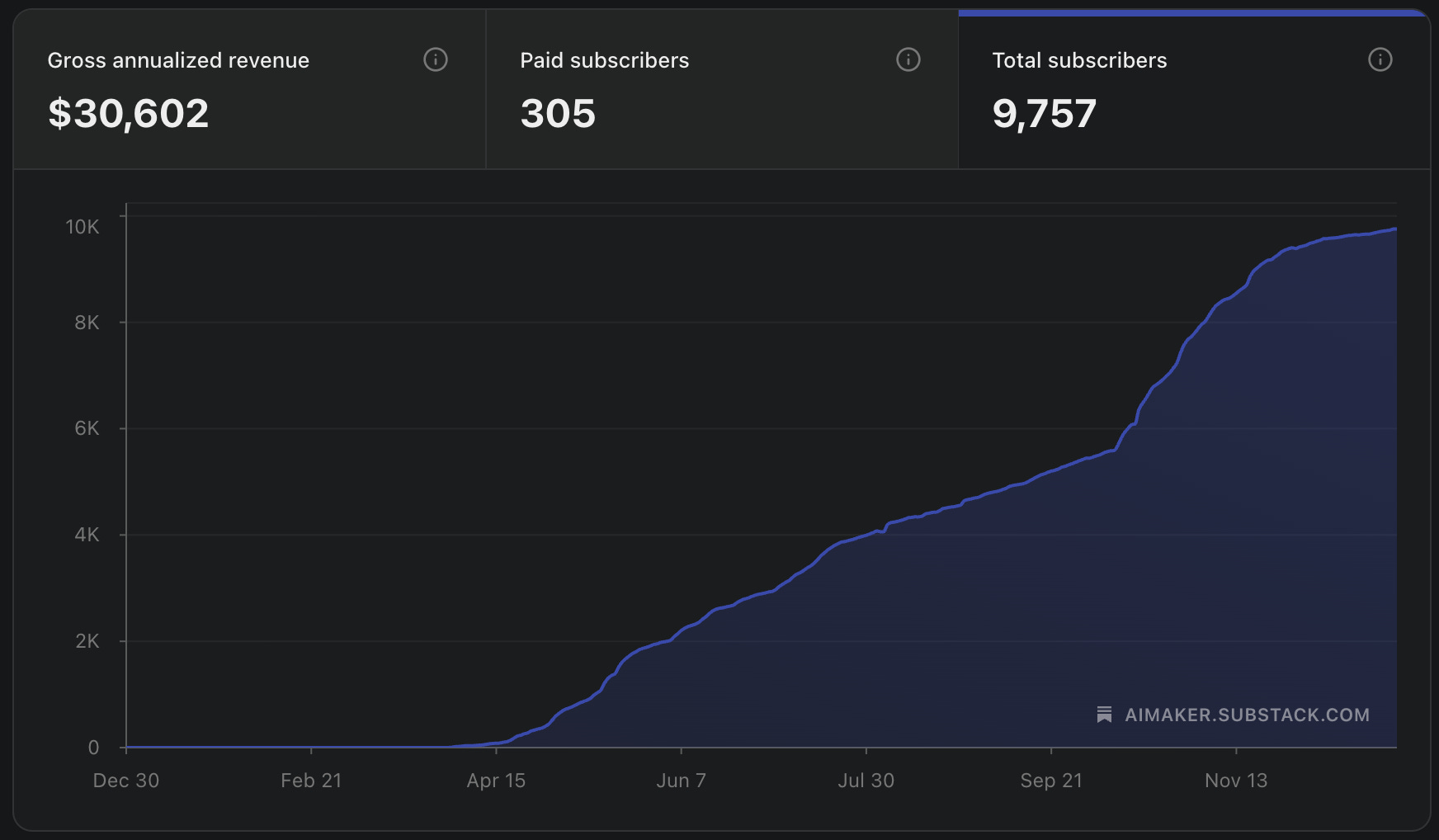
I want to take a moment to appreciate this and thank every one of you for subscribing, let alone reading my long-form posts every single week. I hope they find their way into your inbox each week and help you get better at using AI in your daily life, regardless of where you are in your AI journey or what you’re working on.
Here’s what I want you to know: I grew my Substack from absolute zero. No existing audience. No imported email list. No large following on other platforms to drive traffic from. Most of my readers discovered me through Substack itself—even my LinkedIn has only started growing in the past month, and it’s contributed just a handful of subscribers.
That’s why I’m writing this post. If you’re starting from scratch like I did, or you’re struggling to grow your newsletter, I want to show you exactly what worked, what didn’t, and where those 9,700 subscribers actually came from.
I’m going to break down the subscriber math, share the failures nobody talks about, and give you the complete growth autopsy of building AI Maker. Don’t worry, I won’t gatekeep this post. You’ll learn everything I’m about to share.
Let’s dig in.
How to grow your newsletter on Substack
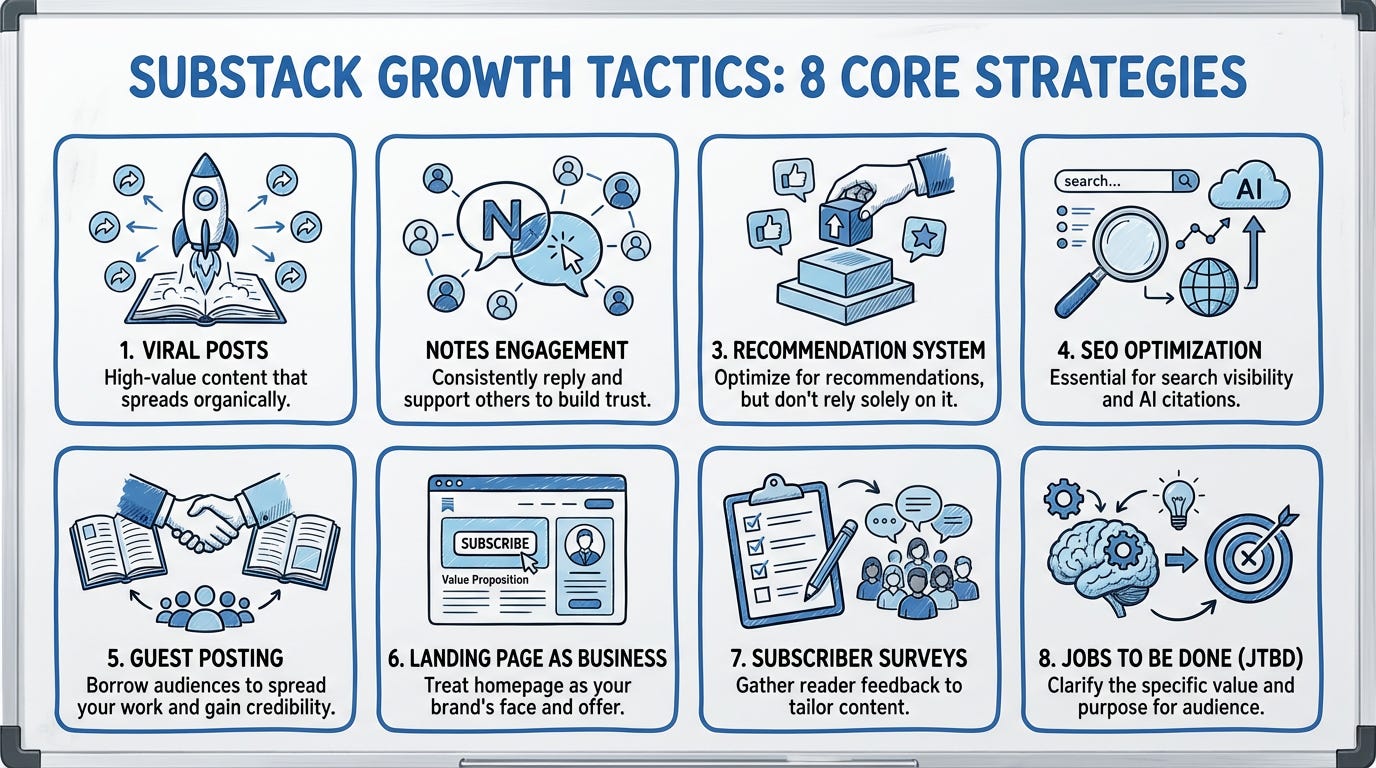
There are many ways to grow your Substack, but since my condition constrained us to using Substack as the main channel, we’re going to focus on this. I won’t be discussing how to get traffic from X, LinkedIn, or other social platforms, but I will cover how to get traffic from SEO (Search Engine Optimization).
1. Your high-value or viral post is still the best chance to grow
Before I show you the tactics, let me be transparent about something: virality is responsible for a significant chunk of my growth. I know that’s not what you want to hear because viral posts aren’t exactly reproducible. But ignoring this reality would be dishonest, so let’s talk about what actually happened and what you can learn from it.
I won’t be able to grow this fast if two of my best posts didn’t go viral: NotebookLM #1 and NotebookLM #2. Both combined were 2000+ subs including those that came from Post notes.
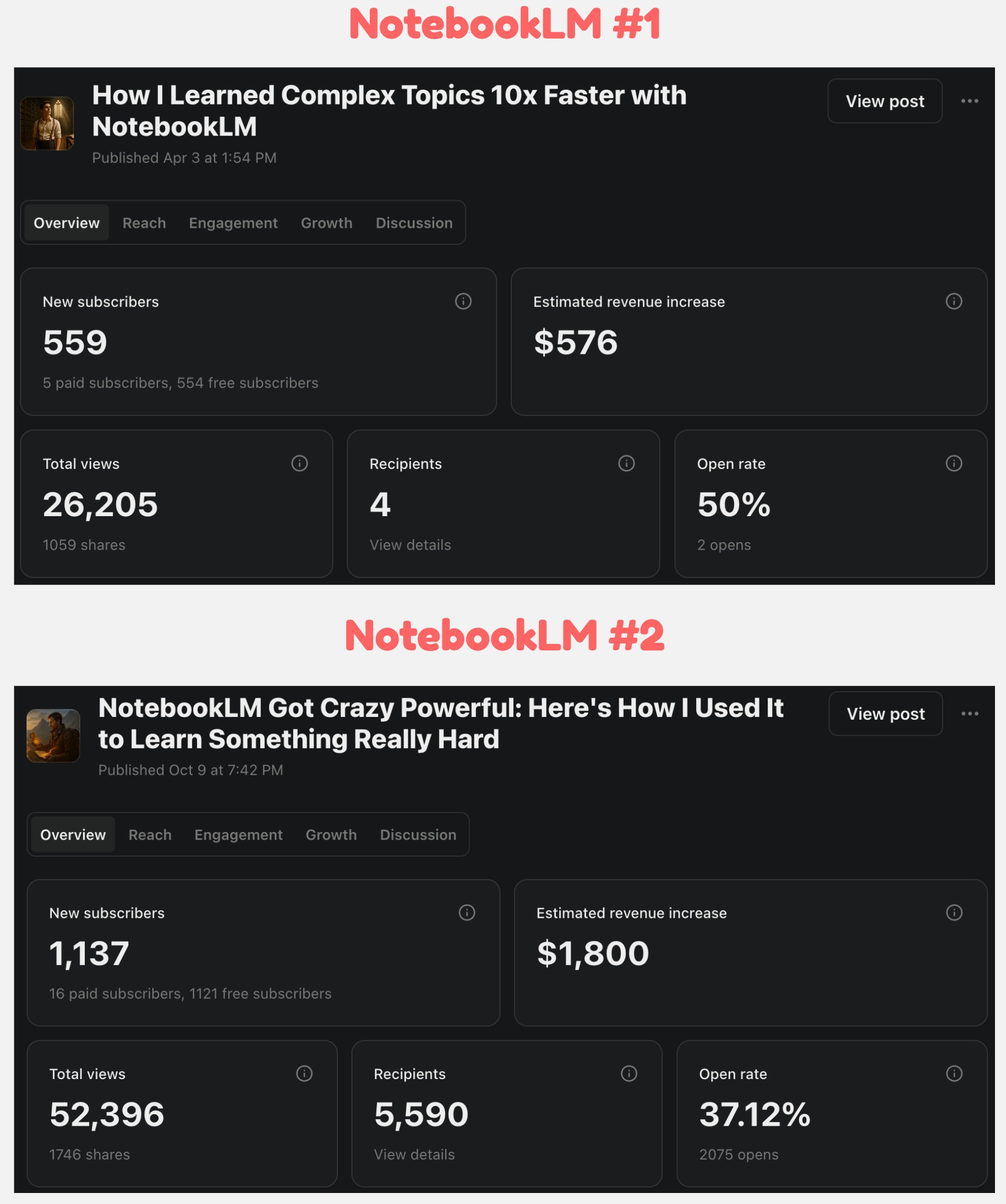
So, technically, it’s around 20–25% of my overall subscribers.
If you ask me whether I knew these posts went viral, of course I wouldn’t have known. When the first NotebookLM post went viral, it only had four recipients (me and a handful friends). What I’ve learned is that Substack has its own segment of people who like to read high‑value posts with a single, specific message and practical steps, especially those that embody a “show, don’t tell” approach. Helping readers experience what you actually write is crucial here.
Aside from that, some of my other posts have also generated subs, which could add up to another ~1,000. Here are some of them:
My AI Therapy Workflow: Turn Claude/ChatGPT and NotebookLM Into Your Self-Discovery Tool
How I Used James Clear’s Atomic Habits to Build 15 AI Systems That Run My Life
Forget Prompting Techniques: How to Make AI Your Thinking Partner
How I Finally Turned AI Into My Personal Operating System for Work
The Ultimate Guide to Turn Claude Into Your Brain’s Most Valuable Co-Worker
Of course, I don’t know if I can create another viral post, and I have no intention of chasing one. In fact, it shouldn’t be the main goal.
Instead, here’s my advice: when you’ve got something unique and a lot to say, spend more time digging into it, write a high-value post you genuinely enjoy, and post it for free. Don’t lock it behind a paid plan. Let it run wild and help you gain more subscribers. Focus on the value and consistency, not the viral outcome.
2. Notes and engagement are your growth engine
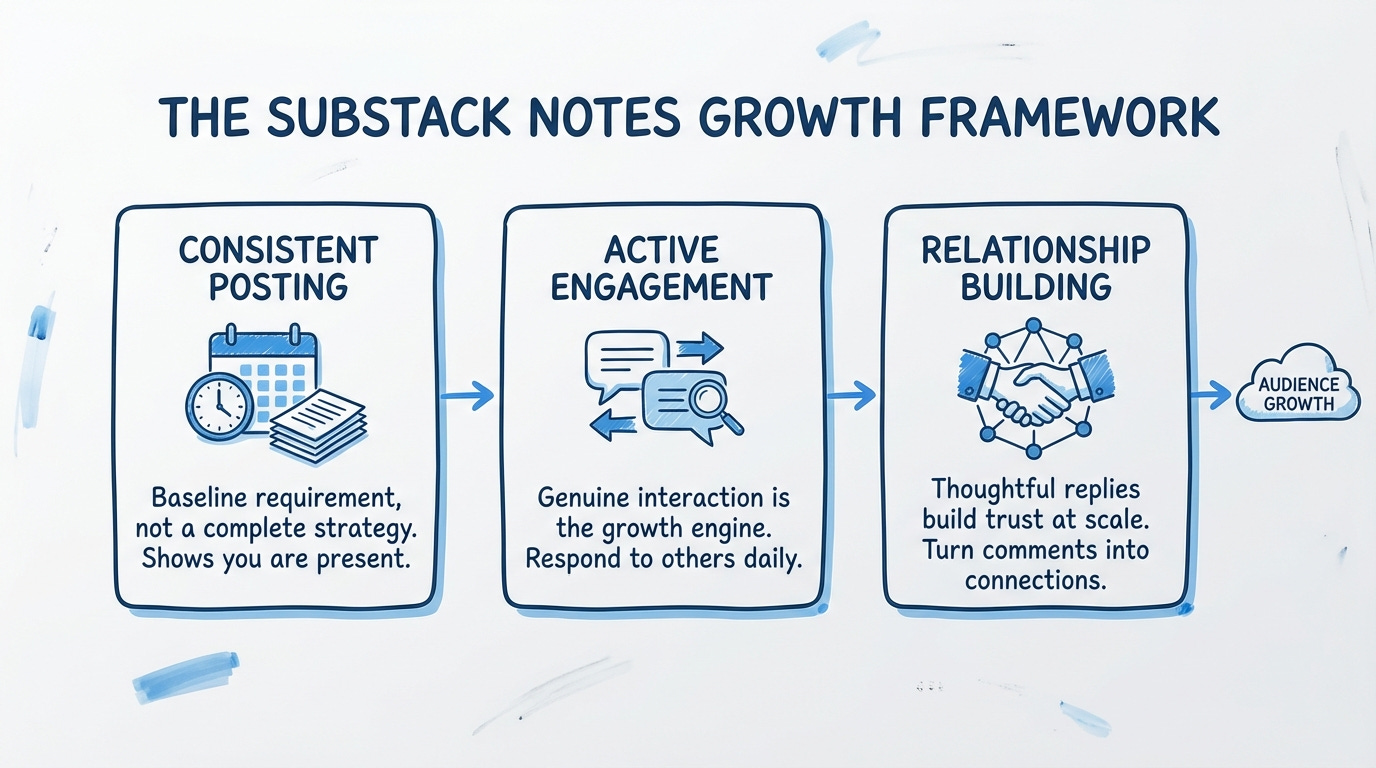
Maybe you’ve heard this a thousand times:
“Post consistently and the right audience will come.”
It’s a half-truth that gives only a partial view of what it actually takes to grow your audience and subscribers on Notes.
Here’s what I mean by half-truth: yes, consistency matters.
I’ve posted 3-4 Notes every day for eight months without missing a day. But posting into the void doesn’t build an audience, posting AND engaging does. Let me break down what actually works.
Notes works much like other social platforms—X, LinkedIn, Threads, etc. Some people say Substack doesn’t have an algorithm; it does. But because people on Substack tend to be more genuine, real, and supportive, the algorithm doesn’t behave as chaotically as X or LinkedIn. It rewards connections. But, fundamentally, it rewards engagements.
Here’s where most advice gets it wrong:
You’ll see big creators post without engaging much with their audience, and people will tell you to follow their strategy. Don’t. They’ve already achieved “escape velocity”—they have enough momentum that their audience comes to them. They can get away with posting Notes without having conversation.
This might sound counterintuitive, but I don’t engage with big creators (well, I used to) because they rarely engage back. I engage with people on a similar trajectory or slightly bigger where we can have real conversations and support each other. That’s what makes the game more fun.
If you’re starting from zero like I did, engagement is non-negotiable. It’s actually your most reliable engine for growth.
You need to engage with other people’s Notes, not just post your own. I’m talking about genuinely responding to what other writers are sharing, not just dropping generic comments for visibility. I aim to engage with 10+ Notes every day: reading, responding, adding value to conversations.
And every single comment on my Notes? I reply to them. Every morning, I spend 30-45 minutes just replying to comments, depending on how many I’ve received.
Over time, I’ve noticed subscribers join simply because I engaged with them consistently. They saw me showing up in conversations, responding thoughtfully, being a real person, and that built trust before they ever read my newsletter.
That’s the part nobody wants to hear because it doesn’t scale easily. But it works.
And this is the part nobody likes hearing: consistency builds trust; it doesn’t guarantee reach.
Now, I hate to say this to you, unfortunately, posting and engaging still aren’t enough to get you more eyeballs. You need to learn how to write engaging notes that fit your brand. This doesn’t mean everything has to be perfectly “on brand.” You can still be as human as possible while sharing the things you care about.
Learn from the best right here. I mean really digest how they structure their Notes, then adjust for your brand. These folks keep showing up on my feed, and their engagement is often higher than mine. That’s fine. It’s a signal.
And please remember: You don’t have to be DAN KOE or Justin Welsh as they’re already on the other side. You just need people a few steps ahead that you can learn from.
Here they are:
By writing engaging notes consistently, some of my posts went viral and others performed above average, which contributed to another 1,000 subscribers (roughly). Here’s the biggest one:
The key thing to remember is to write notes you enjoy, without any expectation of engagement, let alone going viral. When things don’t go as planned, your commitment and enjoyment will keep you moving.
Heads up: Lately, I haven’t engaged with writers here as much because of clashing priorities, and it’s been impacting my Notes engagement, which has dropped over time. I’m sharing this as lessons, and I’m planning to fix this soon.
If you want to leverage Substack Notes to grow, I have an AI automation and Claude Skills that turn your newsletter into 10 Substack Notes by following a psychological framework to write short-form, engaging notes. Consider upgrading to Maker Labs.
3. Play smart with recommendation system
I have mixed feelings about the recommendation system, and my data shows why you should think carefully about optimizing for it.

First of all, I have nothing against Recommendation. I know some people who are optimizing this number. Do what works for you. In fact, I got in total 1,665 subscribers from Recommendation with 125 Substack recommending me. Totally grateful for this.
But here’s why I’m cautious: only 5% of my paid subscriber revenue comes from recommendations, even though they make up 17% of my total subscribers.
The problem is how the recommendation system works. There’s a dark UX pattern involved.
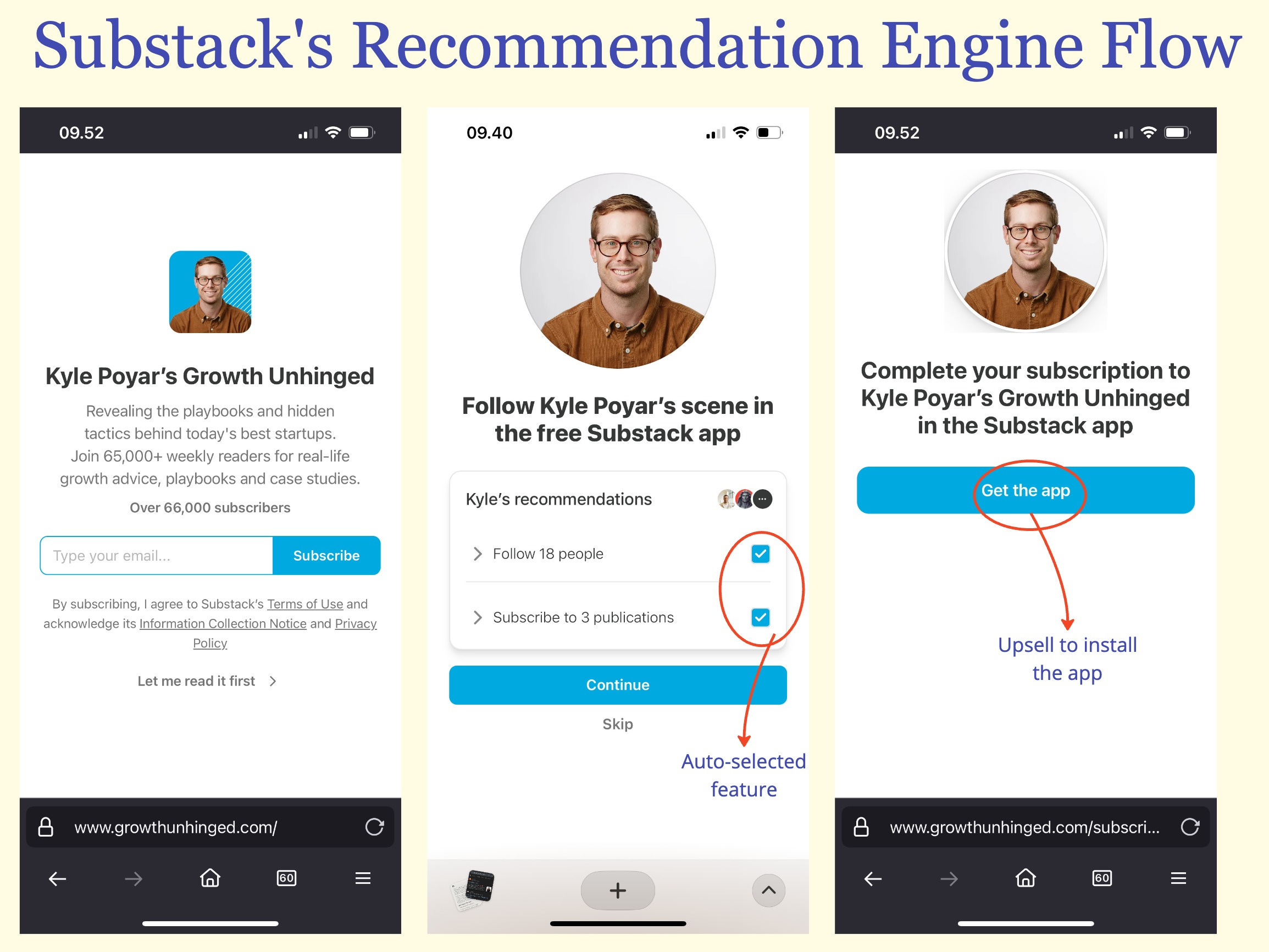
When someone subscribes to another newsletter, Substack shows a modal suggesting other newsletters to subscribe to, including yours. The modal applies an auto-selected feature. Most people click “Subscribe” reflexively just to get through that screen. They haven’t read your content yet. They don’t actually know if they want your newsletter. They’re just clicking through.
You end up with more subscribers but lower engagement. These people didn’t deliberately choose you—they accidentally subscribed while trying to do something else.
All I’m trying to say is: be careful with your tactic. You can ask 500+ people to exchange recommendations, but you’ll end up accumulating more subscribers who don’t even read your posts.
But, what makes me mostly proud is I’ve contributed 2,803 subscribers to other Substacks. These numbers are way more important to me. It’s good to know that some of my subscribers spilled over to other cool AI Substack writers out here.
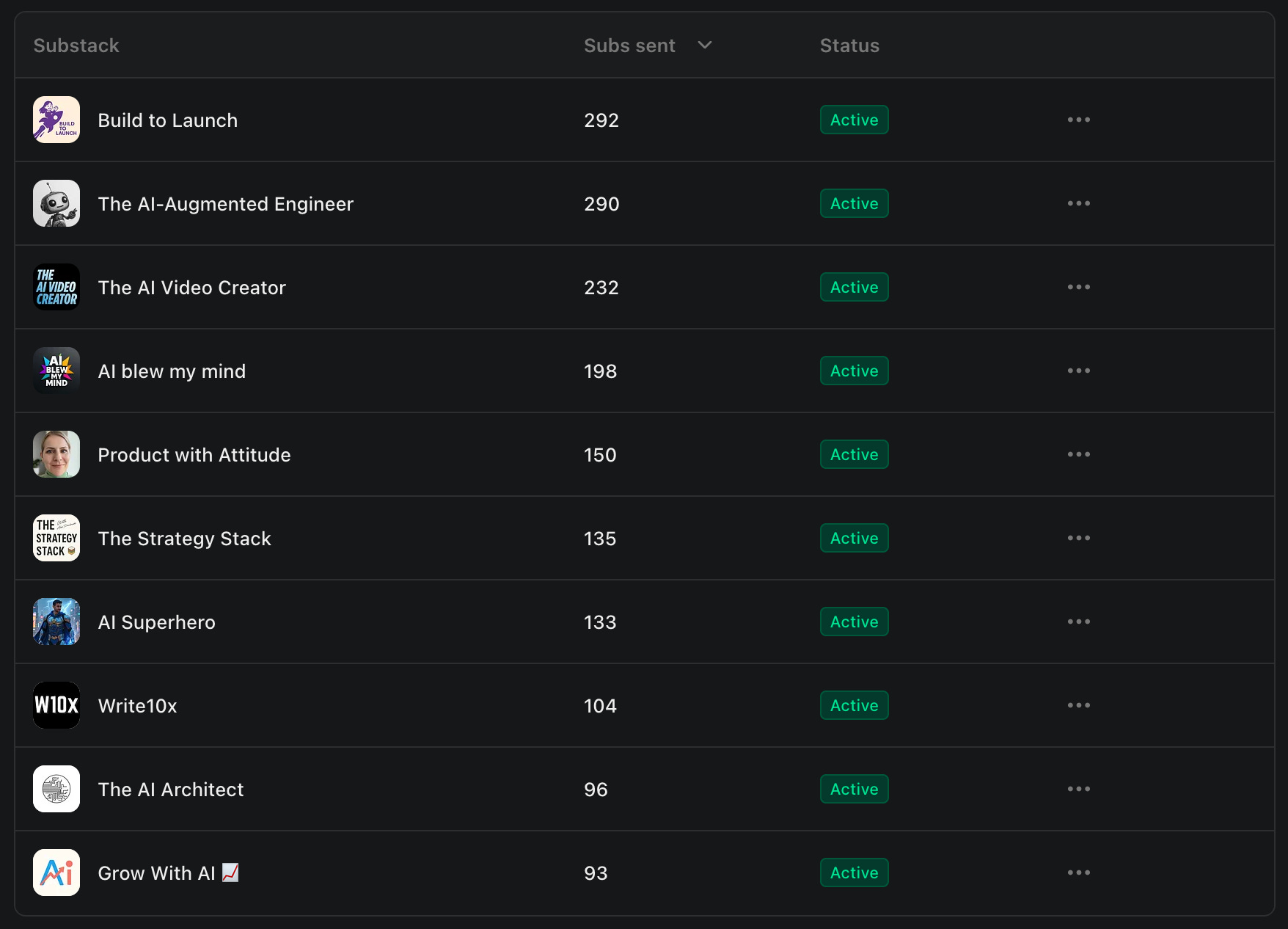
Here’s where I’ve taken a different approach that might seem counterintuitive: I’m selective about who I recommend, not because I’m ungrateful, but because I want my recommendations to actually matter.
Think about it this way: if I recommend 50 newsletters, each one gets a fraction of my audience. But if I recommend 5-10 at a time and rotate them every month, each recommendation becomes more valuable. I’d rather give meaningful subscriber numbers to fewer people than dilute the benefit across dozens.
I’m also only recommending newsletters I genuinely read and believe will serve my audience. My readers subscribed because they trust my judgment on AI content. If I recommend everything, that trust erodes, and ironically, my recommendations become worthless to everyone.
So instead of mass recommendation, I’m building a rotation system: I’ll feature certain Substacks for a set period, then switch to another batch, ensuring more writers get more exposure over time rather than everyone getting a little bit of nothing.
If you’ve recommended me and you’re reading this, thank you. Seriously. I’m exploring ways to give back that create real value: guest post opportunities, collaborations, shoutouts in my posts, and yes, strategic recommendations when the timing and audience fit makes sense.
Anyway, yesterday I read a post by Jenny Ouyang that I found interesting: “Do I need to get recommendations from big creators?”
The answer: You don’t.
Big creators tend to recommend countless Substacks. The chance that your Substack gains new subscribers from them is close to zero. There’s a debate that recommendations can improve SEO, but instead of chasing recommendations, I’d bet on writing guest posts. More on that later.
So my advice is to focus on getting recommendations from people on the same trajectory as you, or slightly bigger. That’s how you can grow together and reap more benefits when one of you hits a jackpot.
4. SEO (Search Engine Optimization)
If you think SEO is dead, you’re on the wrong spectrum. It’s true that people are clicking less on Google search results because of AI, but ignoring SEO will hurt your chances of being cited by AI answers, what we call GEO (Generative Engine Optimization).
Here’s what most people miss: AI search engines like ChatGPT, Perplexity, and Google AI Overviews don’t magically find content. They pull from the same well-structured, high-ranking pages that traditional SEO already favors.
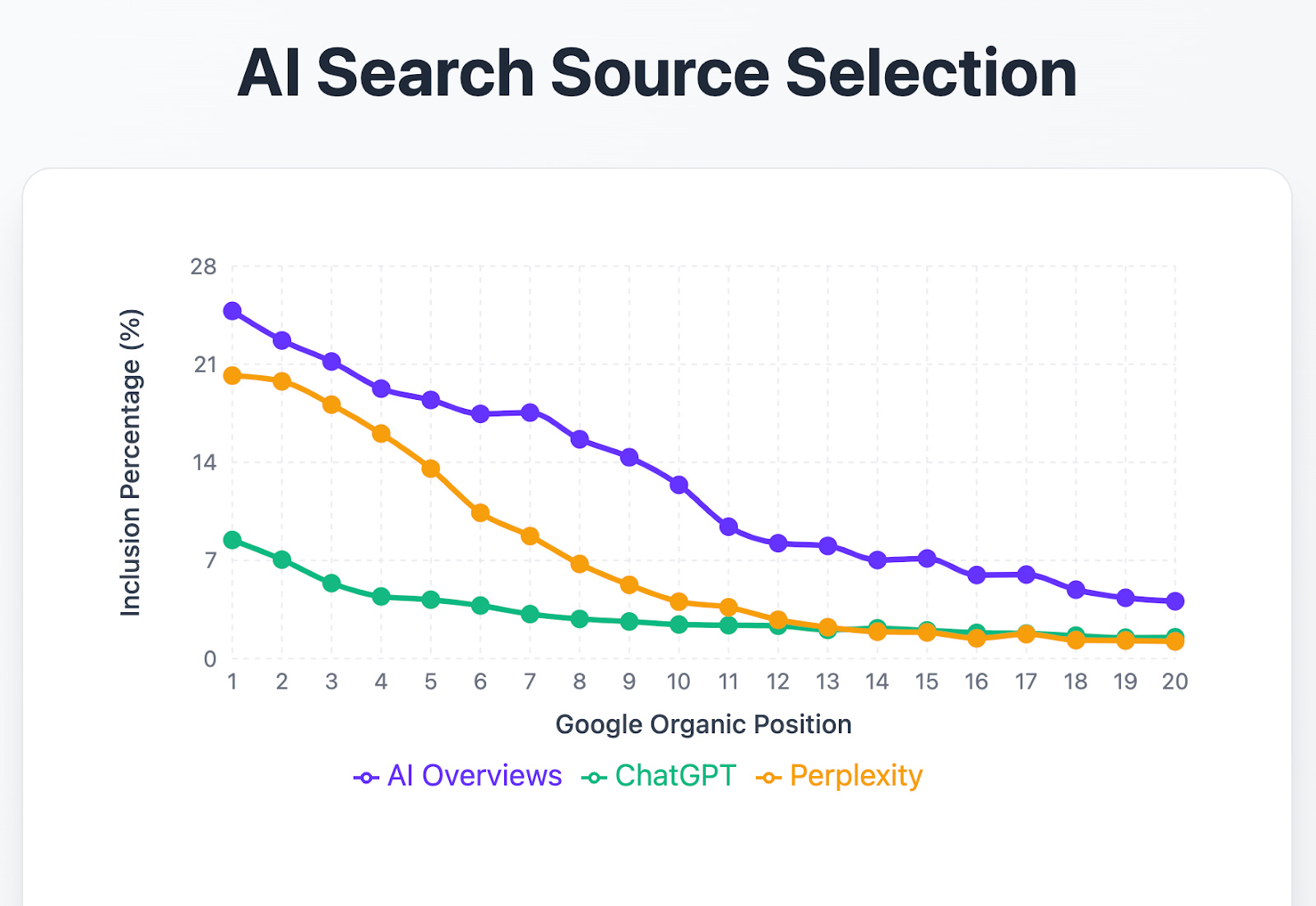
An empirical study across ChatGPT, Perplexity, and Google AI Overviews and found that if your page ranks #1 in traditional Google search, you have about a 25% chance of being cited in AI Overviews. The higher you rank in Google’s top 10, the more likely AI search tools will use you as a source.
Semrush’s AI Overviews study confirmed this: AI Overviews overwhelmingly draw from pages already ranking on page 1 of Google, especially for informational queries. Sites with strong organic visibility and well-optimized content are disproportionately represented in AI answers.
So what does this mean practically?
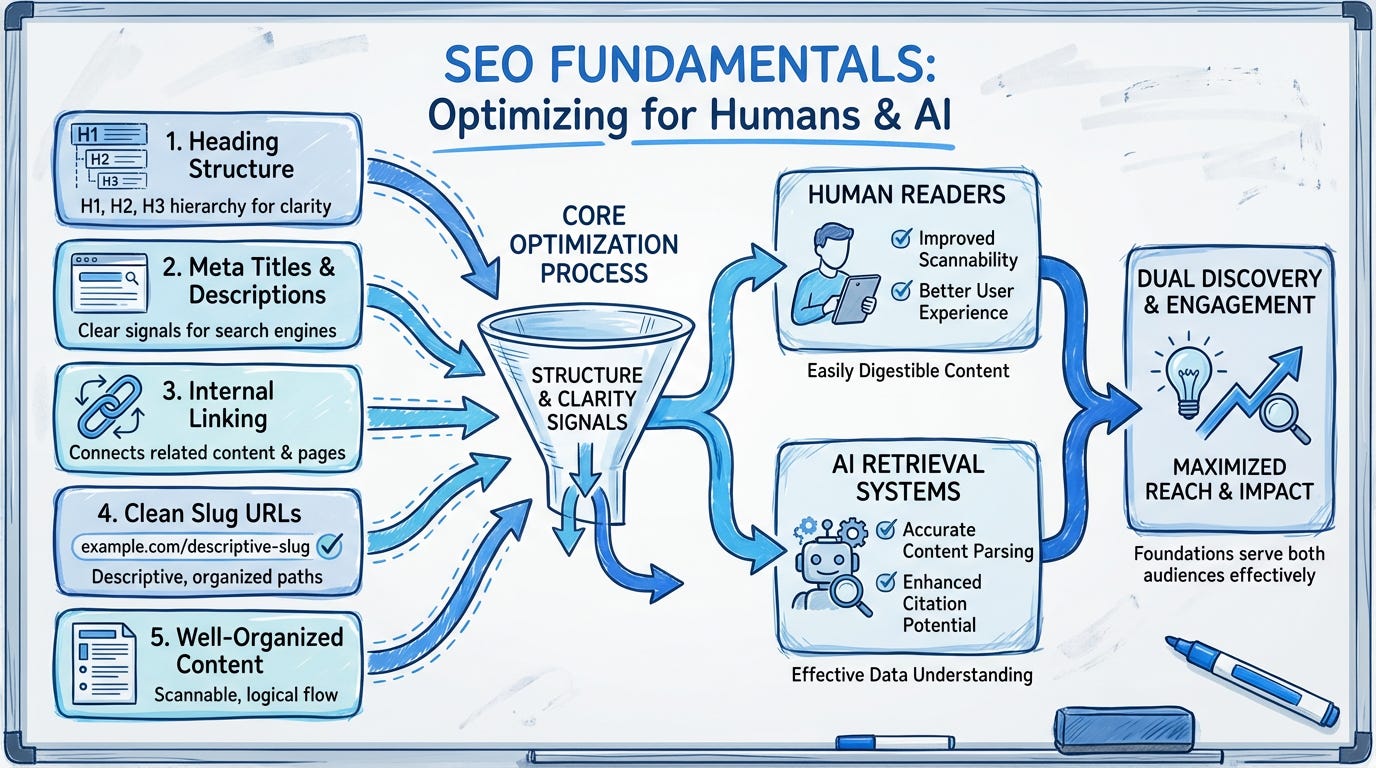
Go back to SEO fundamentals:
Proper heading structure (H1, H2, H3 hierarchy)
Clear meta titles and descriptions
Internal linking between related posts
Clean, descriptive slug URLs
Well-organized, scannable content
These fundamentals are the exact signals AI systems use to understand, parse, and cite your content. When you optimize for clarity and structure, you’re optimizing for both human readers and AI retrieval systems.
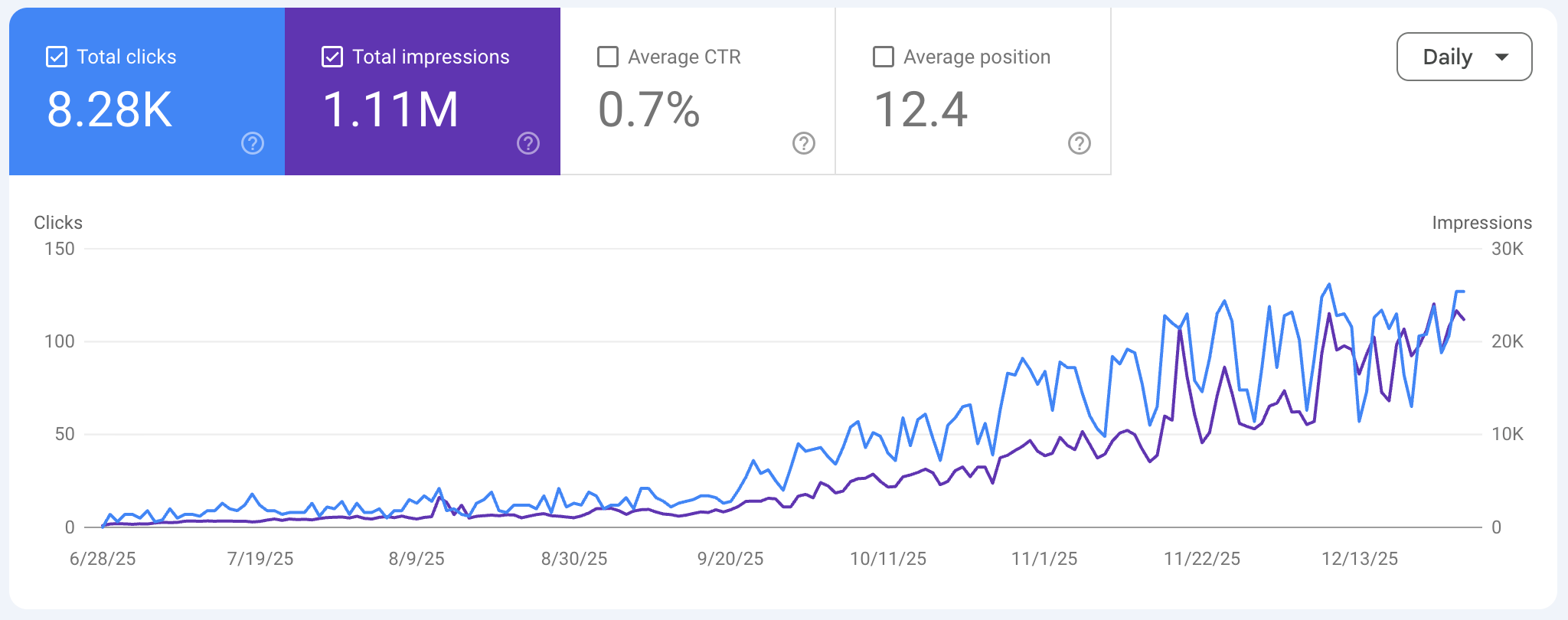
And the results speak for themselves. My organic traffic has been growing steadily with minimal effort because I’m focusing on improving my posts rather than chasing backlinks from Reddit or spamming link farms.
But since I didn’t focus on SEO in the beginning, I still need to improve my existing posts to follow an SEO framework, increase average position, get more clicks, and eventually be cited by AI.
Currently, Google represents less than 5% of subscribers, but it already contributes about 10% of my paid subscription revenue, which is huge given the impact and how low my effort is.
The bottom line: Throw two birds with one stone. Build content that ranks well in traditional search, and AI search engines will naturally follow. I’ll have an in-depth post on SEO/GEO in the later posts. Subscribe so you don’t miss out!
If you want to improve your existing post with the right SEO framework, for AI Maker Lab members, I have a Claude Skill that does two things: Generate SEO report and revise your entire existing post into an SEO-optimized content. Consider upgrading to Maker Labs.
5. Guest posting and doing collaboration are necessary
This is the most and still underrated way to grow your Substack.
I think most of us believe that posting consistently will get us more subscribers. While that’s partially true, it’s also important to get coverage and borrow other people’s large subscriber bases to spread your wings.
Because if you don’t promote your work, who will?
The main thing to remember is to always provide value to whichever Substack you want to write for. Simply reach out and ask if there’s something you could write for them—not to sell something, but to add more value for their readers.
This is what I did for Michael Spencer in the beginning. Over the past 8 months, I’ve written three posts for AI Supremacy—you can check them out here:
Based on my rough calculation, guest posting with AI Supremacy yielded roughly another 1,000 subs. On top of this, I’ve written and contributed another 10 posts for other writers, which include:
When AI Stops Being a Tool and Becomes Your Thinking Partner - Jenny Ouyang, Daria Cupareanu, Joel Salinas, Ryan Ong, Ph.D. 🎮, and TechTiff
How to use NotebookLM and Gemini as your Personal Research Assistant - Barry Winata
When AI Becomes Your Partner, Managing It Becomes Your Job - Jenny Ouyang
I Built My Own AI Creative Partner (And It’s Changing How I Build A Personal Brand) - James Presbitero
Can AI actually increase your effectiveness at work? - Ben Lang
Are You Still Looking for the ‘Perfect’ Way to Use AI? - Joel Salinas
How Wisprflow turned my iPhone into a content machine 🤖 - Creators AI
Build to Thrive | The Blueprint | Week of October 20th, 2025 - Juan Salas-Romer
Snowfall over the AI factory floor (and 25 prompts to clean your slate) - Mia Kiraki 🎭
Most Creators Are Preparing For AI Wrong. Here’s What Actually Works - James Presbitero
Even though I can’t quantify exactly how many subscribers I’ve gained across all guest posts, the backlinks definitely impact my SEO.
These collaborations are actually the root reason I’m taking this approach of allowing more writers to publish for AI Maker. That’s why you’ve been seeing more and more Guest Writers posting every Tuesday.
I want to help other people get noticed, and honestly, writing a newsletter that’s only about me is boring—LOL. Bringing in more voices creates the aliveness of real humans sharing how they use AI, so we can all learn from a diverse community about how people are using AI in their day-to-day lives.
Here are some people who have contributed to AI Maker as Guest Writers, and I want to appreciate their time and effort to write here. Please subscribe to any of them who resonate with you:
The AI Tools Software Engineers Are Using to Supercharge Their Workflow by Jeff Morhous
AI Is The Great Equalizer If You Know How to Use It by Joel Salinas
He Built Google for Newsletters—Here's How the AI Actually Works by Ryan Ong, Ph.D. 🎮
Most People Use AI to Create Content—Smart Creators Use It to Build a Brand by James Presbitero
Why Your Writing Breakthroughs Keep Disappearing by Greg Wolford
I Built an AI to Argue With Me, Here’s Why It’s My Most Valuable Asset by Hannes Thaller
Context Rot Is Already Here. Can We Slow It Down? by Sam Illingworth
The 3-Document System: How I Stopped Losing My Best Ideas Across 100 AI Conversations by Ilia Karelin
How I Used AI to Decode My Genetic Business Blueprint (And Build a Systematic Framework You Can Copy) by Atmos
How Alex Hormozi Posts 250+ Times A Week (And You Can Too) by Timo Mason🤠 | Wealth Writer
4 AI Prompts That Turn You From an Information Collector Into an Insight Creator by Eva Keiffenheim MSc
When NOT to Use AI: The 30-Second Decision That Saves 3 Hours by Ilia Karelin
The 3-Prompt Pipeline: From Substack Article to LinkedIn Post (Without Losing Your Voice) by Benjamin Hies
Beyond Prompting: Building a Data Literate AI Partner by Hodman Murad
Stop Yelling Instructions at a Confident Idiot by Nick Quick
Make.com vs n8n: What Most Reviews Get Wrong About These AI Automation Platforms by Jonas Braadbaart
Overall, I think guest posting is much more important than recommendations because people who choose to subscribe to you are those who have consumed your writing and like it. Over the long term, this will have a better impact on engagement and monetization. You’ll also gain SEO benefits. So, instead of asking for recommendations, I’d suggest reaching out to Substack writers bigger than you and offering value.
In fact, I’m noticing more writers doing this.
Collaboration brings posts to life because real people contribute their real human thoughts. I can see posts like these will have more interaction than typical ones:
Snowfall over the AI factory floor (and 25 prompts to clean your slate)
Most Creators Are Preparing For AI Wrong. Here’s What Actually Works
As AI-generated content starts to take over the internet, purely human work will hold a special place with readers. So, I’m bullish on collaborating through guest posts 💪🏻
6. Treat your Substack like building your business landing page
I’m growing my Substack as a business, not a hobby. I research and keep up with every piece of AI news, curating what I believe will work for me and my readers.
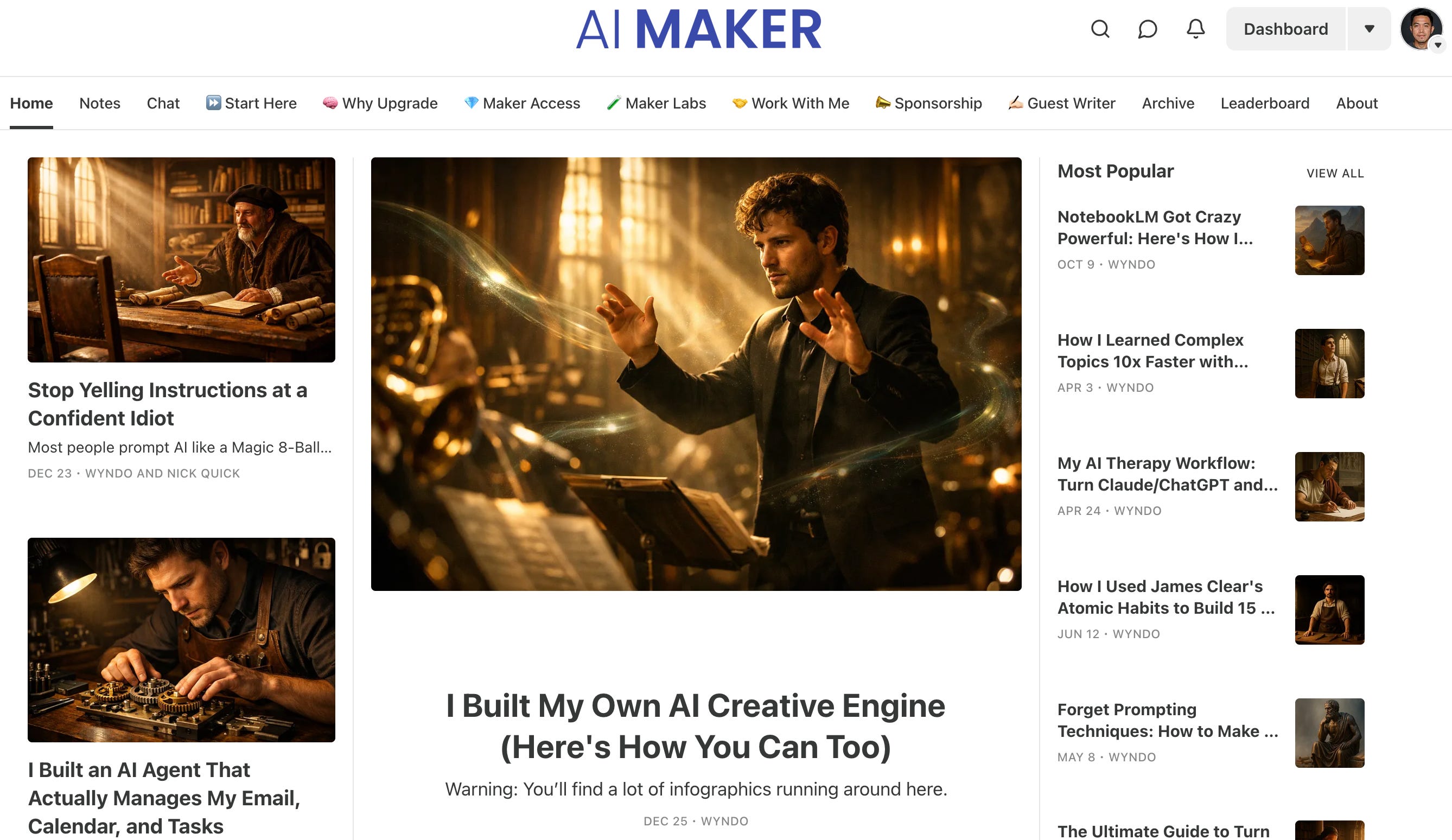
I need to make sure my reader knows exactly what I’m offering, so I take my Substack landing page seriously. Imagine your Substack home page as the face of your brand and ask yourself: “What would I want people to know about me?”
Based on that question, here are all the things I’ve done on my homepage:
1. About page
This is where I tell my story and why I started AI Maker. Your About page builds trust before someone hits subscribe. I use it to explain my background, what makes my perspective unique, and what readers can expect from this newsletter. Think of it as your first impression, make it count. If someone lands on your Substack and can’t figure out who you are or why they should care within 30 seconds, you’ve lost them.
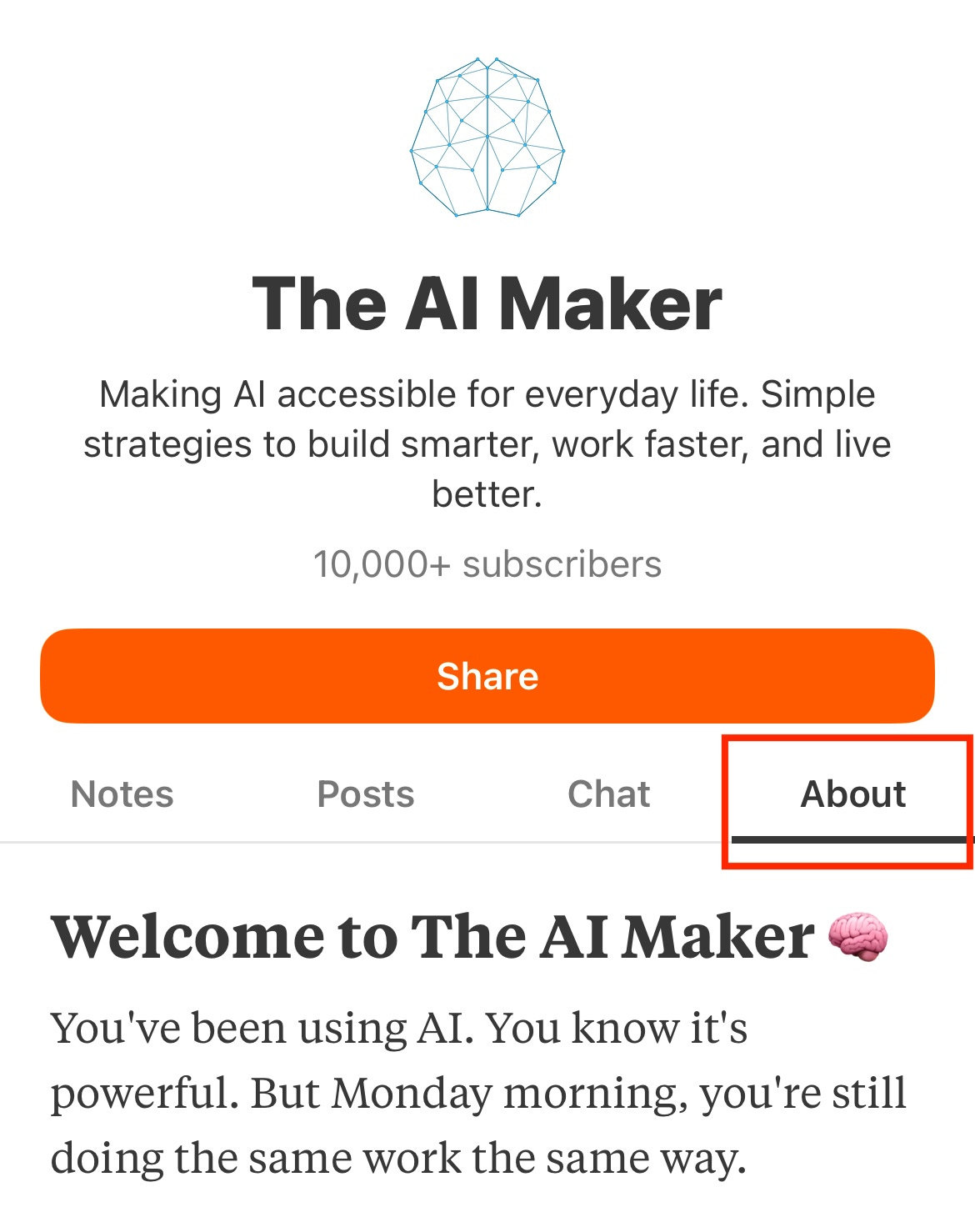
Remember, most of your readers will come from the Substack app, and the only page that sticks there is the About page.
2. Start Here
New subscribers are overwhelmed. They don’t know which post to read first or where to begin their AI journey. My Start Here page solves this by curating the essential posts organized by learning path: AI Workflow Mastery, Tool Mastery, and Thinking Mastery.
It’s essentially an onboarding guide that helps readers find exactly what they need based on where they are. This page has become one of my most valuable assets because it converts casual visitors into engaged readers who know exactly how to navigate my archive.
3. Why Upgrade
I don’t assume people understand the difference between my free and paid content. This page explicitly breaks down what Maker Labs members get: the Thinking Prompt Vault, MCP Workflow Guides, AI Agent Blueprints, Claude Skills, and many other benefits.
I treat this like a sales page because that’s what it is—I’m selling the value of going deeper. Instead of hiding this in a vague “Subscribe” button, I make the value proposition crystal clear so people can make an informed decision about whether the paid tier is right for them.
4. Maker Access
This is the complete resource hub exclusively for Maker Labs members—think of it as the member dashboard. It contains organized access to all premium resources, templates, and tools that paid subscribers get. I created this because I don’t want my paid members hunting through posts to find the implementation guides they paid for. Everything is in one place, well-organized, and easy to reference whenever they’re building something.
5. Maker Labs
This is a dedicated newsletter section that houses all my paid posts, separate from the free content. Instead of mixing everything together in one chronological feed, I created a new section so paid subscribers can easily browse and access premium implementation guides. It also makes it easier for potential subscribers to preview the type of deep-dive content they’ll get if they upgrade. Think of it as your premium product catalog—organized, accessible, and showcasing your best work.
6. Work With Me
Not everyone wants to DIY their AI systems—some people want me to build it for them. This page offers my AI automation consulting service for readers who need hands-on implementation help. It’s an additional revenue stream beyond subscriptions, and it positions me as more than just a writer. If you have expertise your audience needs, create a consulting offering and make it visible.
7. Sponsorship
I use Passionfroot to manage all my sponsorship and advertising opportunities. This page contains my media kit, audience demographics, newsletter performance stats, and sponsorship packages. Instead of handling sponsor inquiries ad-hoc through random emails, I send everyone to this page where they can see exactly what I offer and book directly. It makes it easy for brands to work with me without endless back-and-forth.
But, I don’t have yet advertisers, so if anyone interested, feel free to reach out to me :)
8. Guest Writer
I’ve featured guest writers who bring unique perspectives and expertise to AI Maker. This page showcases everyone who’s contributed to the newsletter and links to their work. It serves two purposes: it gives credit and visibility to contributors, and it shows potential future guest writers that I’m open to collaborations. Building a guest writer program also helps me diversify content and bring fresh voices to my audience without writing every single post myself.
9. Leaderboard
Yes, I have a referral program to encourage people to share AI Maker in return to get access into Maker Labs membership. Earlier, I was thinking to provide another form of bonus but for now, I’m just keeping things simple and only offer membership plan for my audience.
10. Welcome Email
Your welcome email is the first impression new subscribers get, and I treat it like a critical onboarding experience. Mine includes a personalized survey link to understand where readers are in their AI journey, curated links to my best-performing posts so they know where to start, and a direct ask for them to reply with their biggest AI frustration. It's designed to build immediate engagement, gather data about what they need, and set expectations for what they'll get every week.
I also include a soft pitch for my paid tier so new subscribers immediately understand the difference between free strategy posts and paid implementation guides.
You might also need to check out this post by Carrie Loranger, I find it the most useful review on how to grow on Substack.
With these references, run your own exercise to decide what navigation you can leverage on your Substack homepage. Don’t try to be perfect at the beginning. Identify what’s necessary for where you are right now, and add more along the way.
7. Run survey to know who you write for
In the first four months of growing my Substack, I didn’t actually know what to write. I was just vibing my way through my journey.
But as time went by, I got more data on the type of posts that resonated well with my audience. This helped, but nothing was more helpful than just asking them directly.
So when I hit the 2k subscriber mark, I started running a survey for new subscribers and shared the link in my welcome email. This changed everything.
The survey told me exactly what my readers wanted to learn, what their main problems were, and how I could actually help them. I wasn’t guessing anymore, I had real answers from real people who trusted me enough to subscribe.
I learned that most of my readers struggling to move beyond basic ChatGPT prompting. They wanted systems, not tips. They wanted transformation, not productivity hacks. They were looking for frameworks they could actually implement, not abstract AI concepts.
This clarity shaped every post I’ve written since. Instead of writing what I thought people needed, I started writing what they actually told me they needed. The engagement difference was immediate.
Start the survey as soon as you can. Assume you know what to write clearly—whether you have 10, 50, or 100 subscribers. I got in pretty late. Ask them what they’re struggling with, what they want to learn, and what success looks like for them. Then write for those answers.
8. Learn about your JTBD (Jobs To Be Done)
Whether you realize it or not, when we write something, we have a job to fulfill for our audience. It could be helping them get smarter, save time, make better decisions, or build something they couldn’t build before.
Understanding your newsletter’s “Job To Be Done” clarifies what you’re actually writing or selling, and it’s usually not what you think.
Here’s what I learned about my JTBD:
For my free subscribers, the job is to show them what’s possible with AI and help them think differently about how they work. They’re hiring my newsletter to stay informed and inspired without getting lost in technical jargon.
But for my paid members (Maker Labs), the job is much more specific: help them automate at least one work-related task or workflow.
This realization completely changed how I approach paid content. It’s not just about sharing prompts or explaining concepts. My paid subscribers are hiring me to help them save time, work smarter, and build systematic AI workflows they can actually use every day.
So instead of writing generic “advanced AI tips,” I focus on complete implementation blueprints: MCP integrations, automation and agentic workflows, Claude Projects and Skills setups, etc. The goal is always the same: by the end of a paid post, they should be able to automate something real.
Your JTBD shapes everything: what you write, how you structure content, what you charge for, and how you measure success.
If you don’t know your newsletter’s Job To Be Done yet, go back to your survey responses or analyze your most engaging posts. Look for patterns in what people say they need. The answer is usually right there.
Or, if you don’t have readers survey yet, use this prompt to uncover your JTBD:
I run a newsletter about [YOUR TOPIC] and I want to understand my newsletter's "Job To Be Done" (JTBD) for my readers.

Help me uncover my JTBD by asking me questions about my audience, content, and the transformation I provide. Use the JTBD framework:

"When [situation], I want to [motivation], so I can [expected outcome]."

Here's what you should ask me about:

1. My audience demographics and their current situation
2. The common problems or frustrations they face
3. What they're currently using/doing to solve these problems (and why it's not working)
4. The transformation or outcome my newsletter provides
5. What success looks like for my readers after engaging with my content
6. The emotional and functional needs my newsletter fulfills
7. What readers would lose or miss if my newsletter disappeared

After gathering this information, help me:
- Identify my core JTBD for free subscribers
- Identify my core JTBD for paid subscribers (if applicable)
- Craft clear JTBD statements for each audience segment
- Suggest how this JTBD should shape my content strategy

Ask me these questions one at a time, each question need to be built on top of another and based on my answers, help me articulate my newsletter's true Job To Be Done.
If I started over today, here’s what I’d do
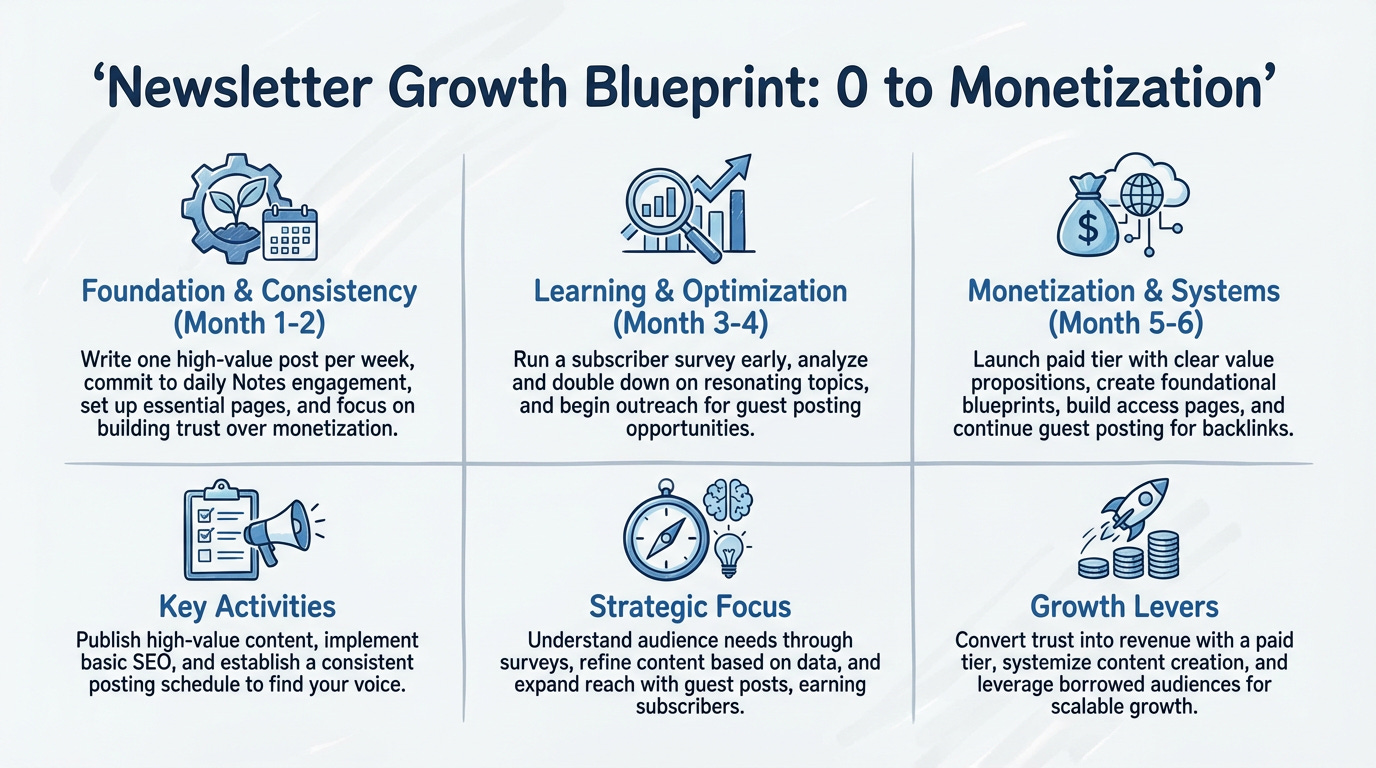
Now that you’ve seen the full breakdown: the viral posts, the Notes grind, the recommendation complexity, the SEO fundamentals, let me distill this into what I’d actually focus on if I were starting from zero again today.
Month 1-2: Foundation & Consistency
Write one high-value post per week focusing on a specific transformation or framework
Post 3-4 Notes every day and engage with 10+ other people’s Notes every morning
Set up the essential pages: About, Start Here, and Welcome Email
Don’t worry about monetization yet, focus on finding your voice and building trust
Start implementing basic SEO: proper headings, meta descriptions, clean URLs, internal linking
Month 3-4: Learning & Optimization
Run a subscriber survey as soon as you hit 100-500 subscribers (don’t wait like I did)
Analyze which posts resonate and double down on those topics
Begin reaching out to 2-3 newsletters for guest posting opportunities (this can start from month 2)
Occasionally, ask for recommendations but this is not the main activity, I’d rather be focus on earning subscribers, not exchanging them
Month 5-6: Monetization & Systems
Launch paid tier once I understand my JTBD clearly from survey responses
Create 3-5 foundational paid posts that deliver complete implementation blueprints
Build out Member Access page and Why Upgrade page with clear value propositions
Continue guest posting to borrow larger audiences and build backlinks
Keep engaging on Notes—this never stops being important
What I’d skip or do less:
Chasing recommendation exchanges (low-quality subscribers, minimal paid conversion)
Optimizing for virality (you can’t control it, so don’t make it your strategy)
Building a content calendar more than 3-4 weeks out (vibe-based writing works better for me)
Overthinking the “perfect” homepage setup (start simple, add as you grow)
The One Thing That Matters Most
If I could only do one thing differently, I’d start the survey earlier and guest post more aggressively in months 2-4. Those two strategies gave me the clearest signal on what to write and the fastest subscriber growth from engaged readers.
Everything else—Notes, SEO, viral posts—compounds over time. But understanding your JTBD and getting in front of other audiences accelerates everything.
The truth is, you don’t need to do everything I did. You just need to do the things that actually moved the needle, and now you know exactly what those are.
I built AI Maker in public because I believe in full transparency. If sharing this breakdown helps even one person avoid the mistakes I made or accelerates their growth by a few months, it was worth writing.
So go build. Start messy. Post consistently. Engage genuinely. Survey early. Guest post often. And remember: you’re not building a subscriber count—you’re building an audience of people who trust you enough to let you into their inbox every week.
That’s the real work. Everything else is just tactics.
Thanks for being here,
Wyndo
P.S. If you found this helpful, the best way to support this newsletter is to share it with one person who’s thinking about starting their own Substack and interested with AI. And if you want the behind-the-scenes automation systems I use to run AI Maker—the Claude Skills for SEO optimization, the newsletter-to-Notes pipeline, infographic generator I used in this post—that’s all inside Maker Labs.
It's been incredible watching your growth Wyndo, very inspiring. Your articles bring a ton of value, every single time. Hope to collaborate with you in 2026 🤗
Wyndo, I relate so much to everything you shared! Especially those points:
First, I didn’t even realize I was #1 on your recommendation list! I’m honestly humbled and grateful for that!
The virality of your two NotebookLM articles is incredible. So many people never quite get any of that at all.
SEO was definitely a painful mistake for me too (I talked about it in my post), but thankfully I’ve been able to course-correct.
And the point about the About page being the main entry point in the Substack app is such an important one. A lot of people optimize for desktop and completely forget the app experience.
Great suggestions! We are just starting!